
Canada has a long history with uranium, and uranium mining in Canada remains closely tied to the country’s energy and mineral resources sector. Most of Canada’s operating uranium mines and mills are located in northern Saskatchewan, within or around the Athabasca Basin, one of the world’s best-known uranium-producing regions. But the story does not begin with a mine. Before a deposit can be developed, companies spend years exploring, drilling and evaluating the geology to determine whether a project has real potential.
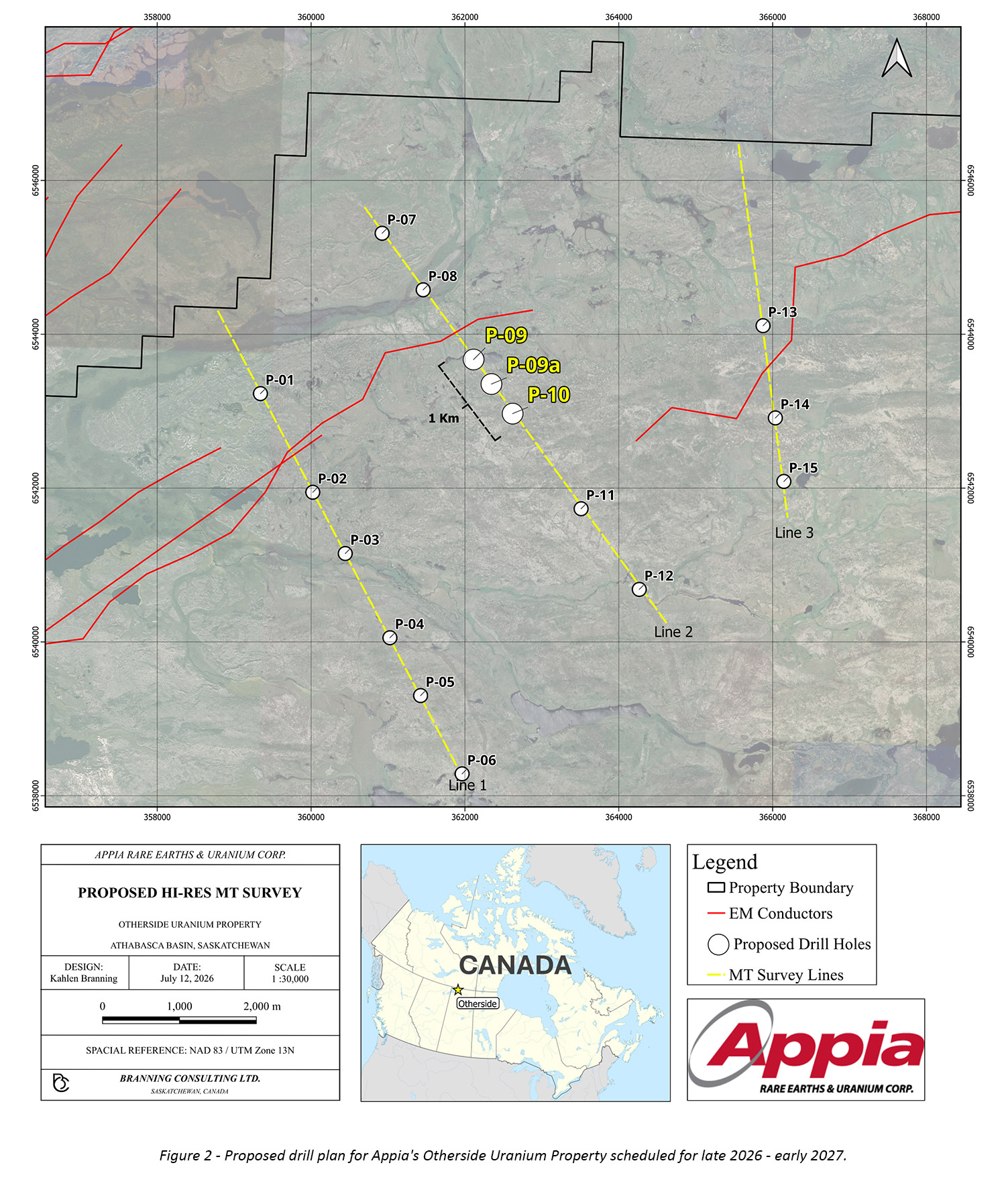
For Appia Rare Earths & Uranium Corp., early-stage exploration for uranium in and around Saskatchewan’s Athabasca Basin is their focus. The company is investigating uranium opportunities in Saskatchewan’s Athabasca Basin through its Otherside, Loranger, North Wollaston and Eastside properties (Figure 1), with the Otherside Uranium Property planned for the first stage of drilling in late 2026 – early 2027 (Figure 2).
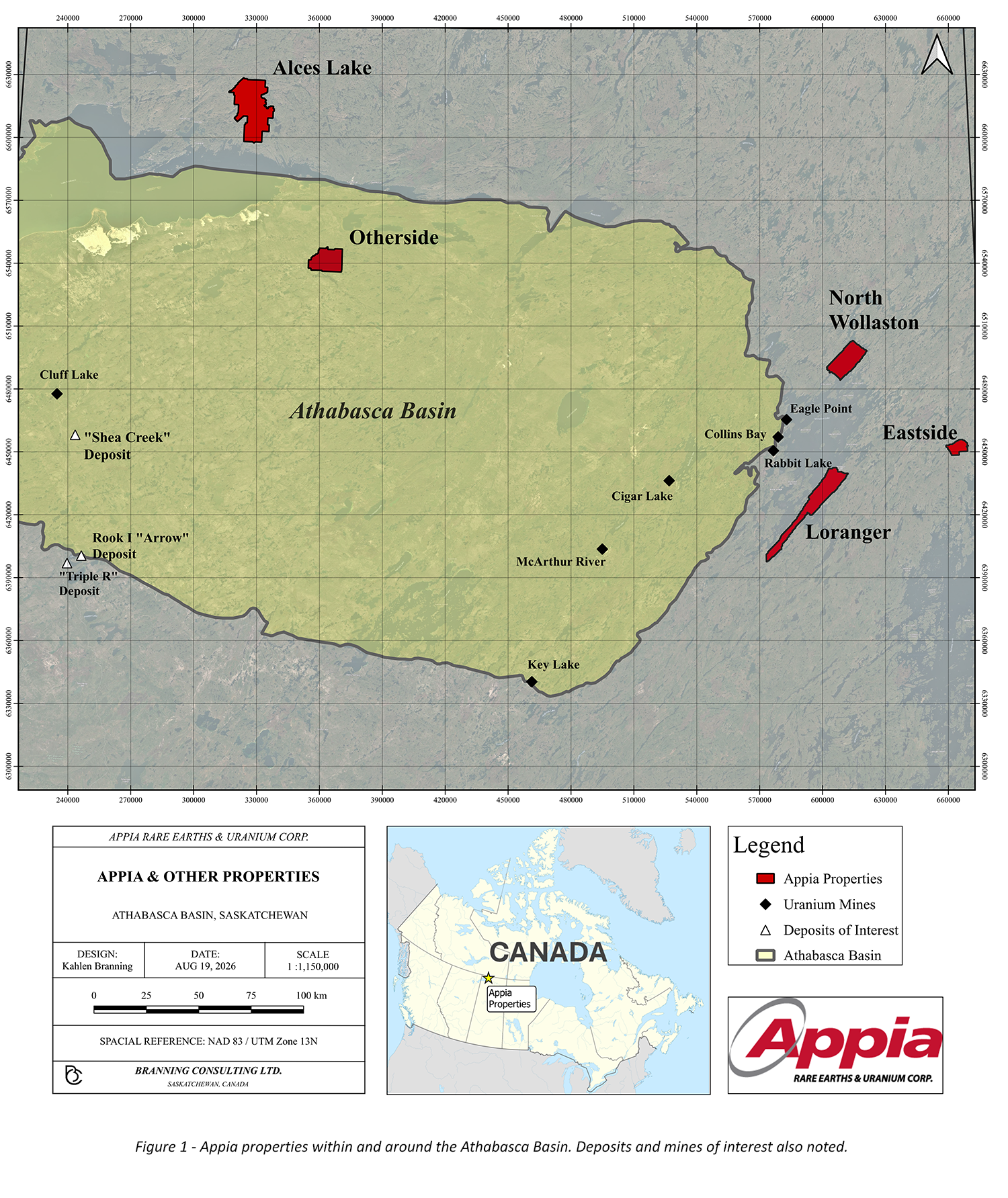
Canada is one of the world’s major uranium producers, and the country’s uranium industry is concentrated heavily in Saskatchewan. According to the Canadian Nuclear Safety Commission (CNSC), all currently operating uranium mines and mills in Canada are located in northern Saskatchewan. These include Cigar Lake, McArthur River, McClean Lake, Key Lake and Rabbit Lake.
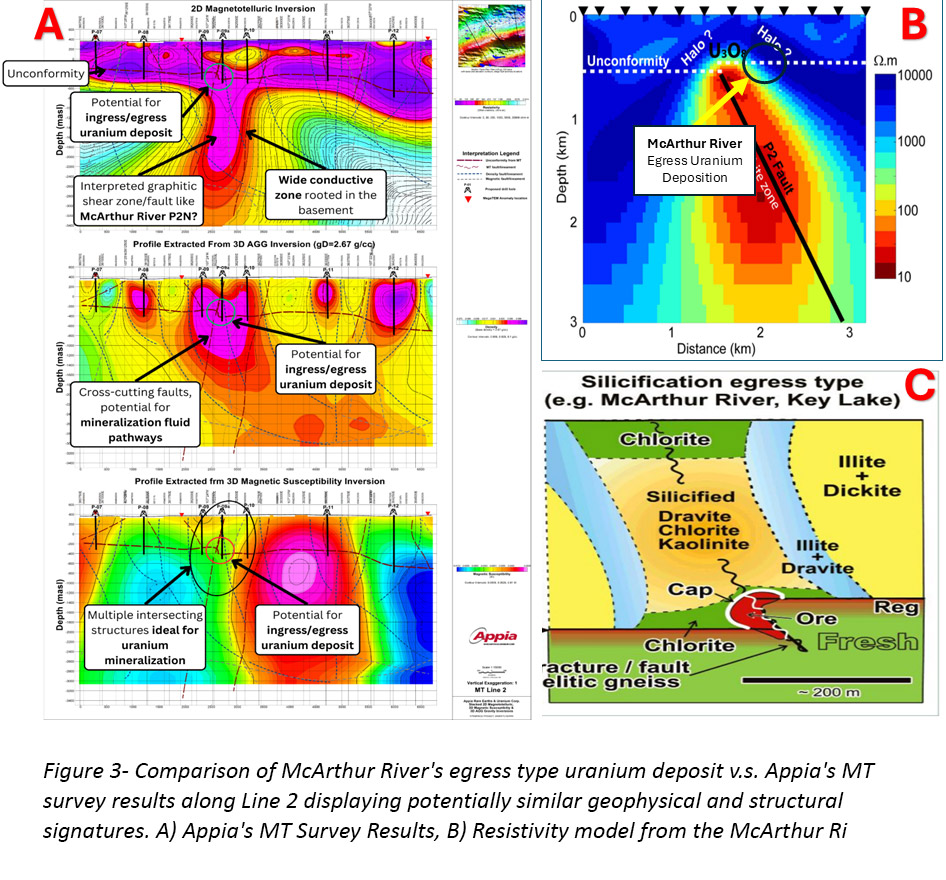
Cameco’s McArthur River deposit is of particular relevance to Appia’s exploration strategy. The combined results of Appia’s ground-based magnetotelluric (MT), airborne gravity and airborne magnetic surveys identified several geophysical features at the Otherside property that are comparable to exploration vectors associated with the high-grade McArthur River deposit, which hosts mineral reserves of 346.5 million pounds U₃O₈ grading 6.48% U₃O₈ (Source: Cameco, 2025 Mineral Reserves and Resources). These features include an approximately 100-meter offset in the unconformity, a deep electromagnetic conductor system, multiple interpreted faults and high-density, chimney-like responses within the overlying sandstone (see press release dated June 29, 2026 and Figure 3 below)
When people search for uranium mines in Canada, Saskatchewan is the province that comes up frequently—and for good reason. The province’s northern uranium districts host some of the country’s most important deposits and operating facilities.
Saskatchewan also has a pipeline of uranium projects at different stages of development. NexGen Energy’s Rook I Project, which hosts the Arrow Deposit, received a CNSC licence authorizing site preparation and construction in March 2026. Arrow has Probable Mineral Reserves of 4.575 million tonnes grading 2.37% U₃O₈ and containing 239.6 million pounds U₃O₈. (Source: NexGen Energy, 2021 Feasibility Study) (CNSC Rook I status) Denison Mines’ Wheeler River Project received a similar CNSC licence in February 2026. Its Phoenix Deposit has Proven and Probable Mineral Reserves of 219,000 tonnes grading 11.7% U₃O₈ and representing an estimated 56.7 million recoverable pounds U₃O₈. (Source: Denison Mines, 2023 Phoenix Feasibility Study) (CNSC Wheeler River status)
By comparison, IsoEnergy’s Hurricane Deposit remains a mineral-resource-stage project rather than an operating mine. Hurricane has an Indicated Mineral Resource of 63,800 tonnes grading 34.5% U₃O₈ and containing 48.61 million pounds U₃O₈, plus an Inferred Mineral Resource of 54,300 tonnes grading 2.2% U₃O₈ and containing 2.66 million pounds U₃O₈. (Source: IsoEnergy, Mineral Resource effective July 8, 2022)
There is a big difference between uranium mining in Canada and uranium exploration. Mining is the result of a long development process; exploration is where that process starts.
At an exploration property, companies may conduct geological mapping, prospecting, geochemical work and airborne or ground-based geophysical surveys. The information gathered from these programs helps geologists build a picture of what may be happening below the surface.
Drilling then provides a more direct way to test those ideas. Even an encouraging drill result, however, does not automatically mean a mine will follow. More drilling, resource evaluation, metallurgical work, environmental studies, permitting and financing may all be required.
Appia’s Saskatchewan properties are therefore classified as uranium exploration properties. They are exploration-stage projects with the potential to develop into a mine in the future. The company is working to identify and evaluate prospective uranium mineralization in the Athabasca Basin.
Uranium production in Canada is largely centred on northern Saskatchewan, where established mines and mills form an important part of the country’s uranium sector. The CNSC notes that most Canadian uranium production is exported, making the industry relevant not only to Canada’s domestic resources sector but also to the international nuclear fuel market.
Production, however, represents a much later stage than exploration. An exploration company may spend years testing a property before there is enough information to determine whether development is warranted.
That is why exploration results should be viewed carefully. A promising target can be an encouraging sign, but it is not the same as a defined mineral resource, an operating mine or future production.
The path from uranium ore to nuclear fuel involves several stages. Uranium is mined from the ground and taken to a mill, where it is processed into uranium concentrate. That concentrate can then go through further processing before becoming fuel for nuclear reactors.
This established industry is one reason Saskatchewan continues to attract exploration activity. Existing infrastructure, technical knowledge and decades of geological work provide explorers with a useful foundation when looking for new opportunities.
Interest in uranium stocks Canada can rise and fall with uranium prices, nuclear energy demand, project developments and broader market conditions. But not all uranium-related companies carry the same type of exposure.
A producing company may have revenue from an operating mine, while an exploration company generally depends much more heavily on exploration success, financing and the ability to advance its properties. That makes understanding a company’s stage of development especially important when assessing uranium-related investments.
For an exploration company such as Appia, the potential is tied to what its ongoing geological work and drilling programs may reveal. Exploration carries inherent uncertainty, and prospective targets do not guarantee that commercially viable deposits will be discovered.
The future of Canada’s uranium sector will involve more than the mines already in operation. Continued exploration will be important in identifying potential resources that could contribute to the industry over the longer term.
For Appia, the focus remains on exploration rather than production. Its Saskatchewan portfolio gives the company exposure to the Athabasca Basin and its well-established uranium geology, while ongoing geophysical work and drilling are being used to refine and test targets.
The distinction is simple but important: uranium mining in Canada represents the mature end of the development cycle, while exploration is where tomorrow’s potential discoveries begin. Appia’s role is firmly at that earlier stage—gathering evidence, testing targets and working to understand what its Saskatchewan properties may hold.