
Interest in Rare Earth Stocks has increased as rare earth elements have become more closely connected to permanent magnets, electric vehicles, wind turbines, electronics and other advanced technologies. Permanent magnets represented 47.6% of global rare earth element demand in 2024. For investors, however, evaluating a rare earth company requires more than considering market demand. It also means understanding the company’s ownership structure, project stage, exploration results, available funding and the technical work still required. (Source: Natural Resources Canada, Rare Earth Elements Facts)
For investors looking at Rare Earth Stocks Canada, Appia Rare Earths & Uranium Corp. is a Canadian-listed mineral exploration company with rare earth exposure in Canada and Brazil. Appia trades on the Canadian Securities Exchange under the symbol API. Its Canadian rare earth assets include the 100%-owned Alces Lake Project, while its Brazilian exposure is held through a 25% equity interest in Ultra Rare Earth Inc.(See Appia press release dated June 1, 2026)
Rare earth elements possess magnetic, chemical and luminescent properties that support a wide range of industrial and high-technology applications. Neodymium and praseodymium are important components of permanent magnets, while dysprosium and terbium are used in specialized, high-performance magnet applications.
Rare earth supply is also highly concentrated. China accounted for approximately 69% of global mined production and 90% of refined rare earth supply in 2024, while China and Myanmar remained almost the sole producers of highly valued heavy rare earth elements. (Source: Natural Resources Canada, Rare Earth Elements Facts)
Developing new mineral sources takes time. Exploration companies must complete mapping, geophysics, sampling, drilling and technical studies before they can determine whether mineralization may support a Mineral Resource, Mineral Reserve or future mine. Exploration results alone do not guarantee future production.
That is where Rare Earth Stocks Canada can become an area for further research. Canadian-listed exploration companies may provide exposure to projects at different stages, but early-stage exploration carries considerable geological, technical, financing and market uncertainty.
Appia’s rare earth portfolio provides direct exposure to exploration in Saskatchewan and indirect exposure to projects in Goiás, Brazil.
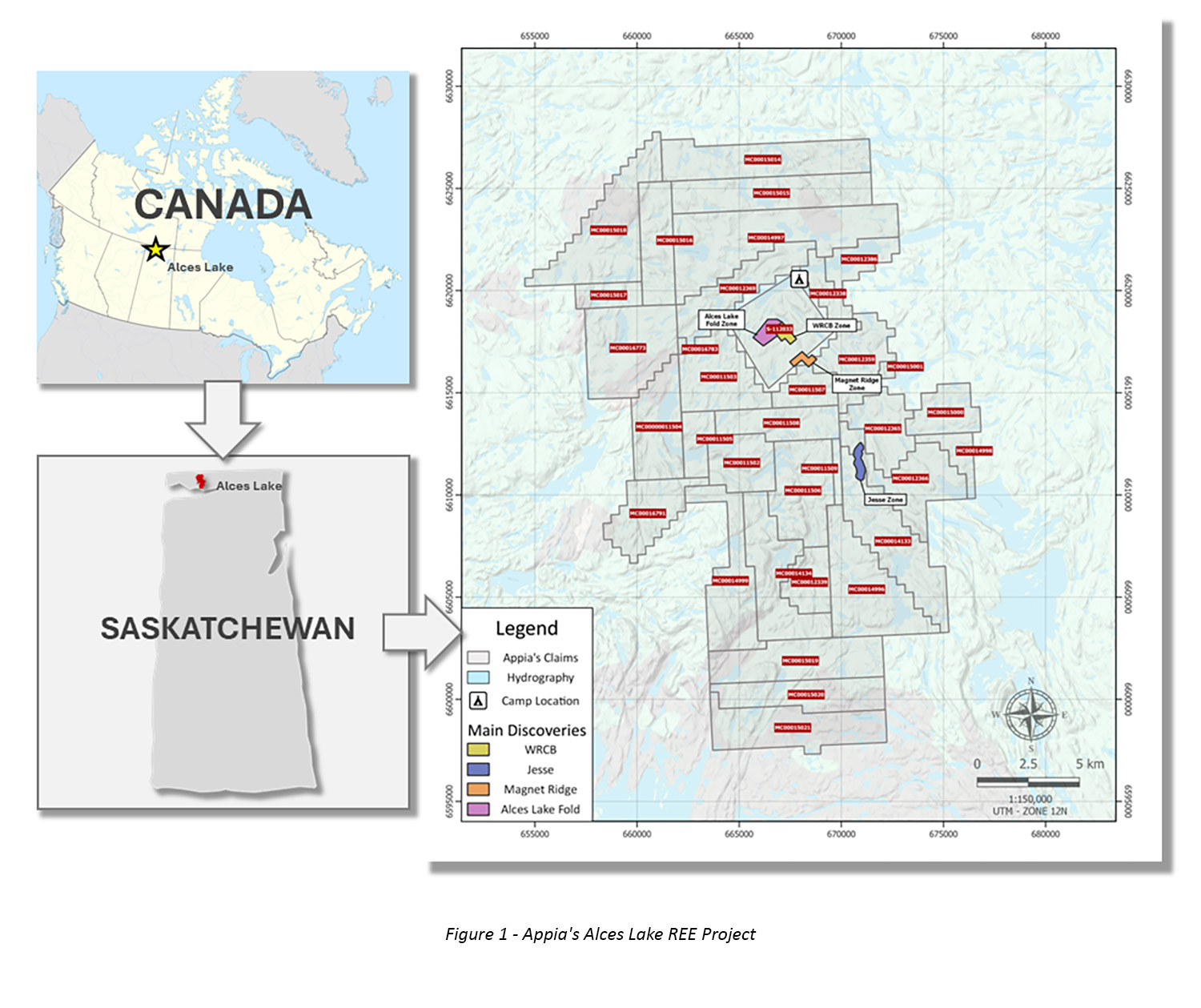
In Saskatchewan, Appia’s 100%-owned Alces Lake Project (Figure 1) covers approximately 38,522 hectares and hosts mineralization containing neodymium, praseodymium, dysprosium and terbium. Historical drilling in hole IV-19-012 returned 16.059 wt.% TREO over 15.55 meters, including 49.17 wt.% TREO over 3.70 meters. (See Appia press release dated August 6, 2026)
In Brazil, Appia holds a 25% equity interest in Ultra Rare Earth Inc., which indirectly holds a 100% interest in the Ultra Hard Rock and Ultra IAC Projects in Goiás (Figure 2). Together, the projects cover 42,932.24 hectares. (See Appia press release dated June 1, 2026)
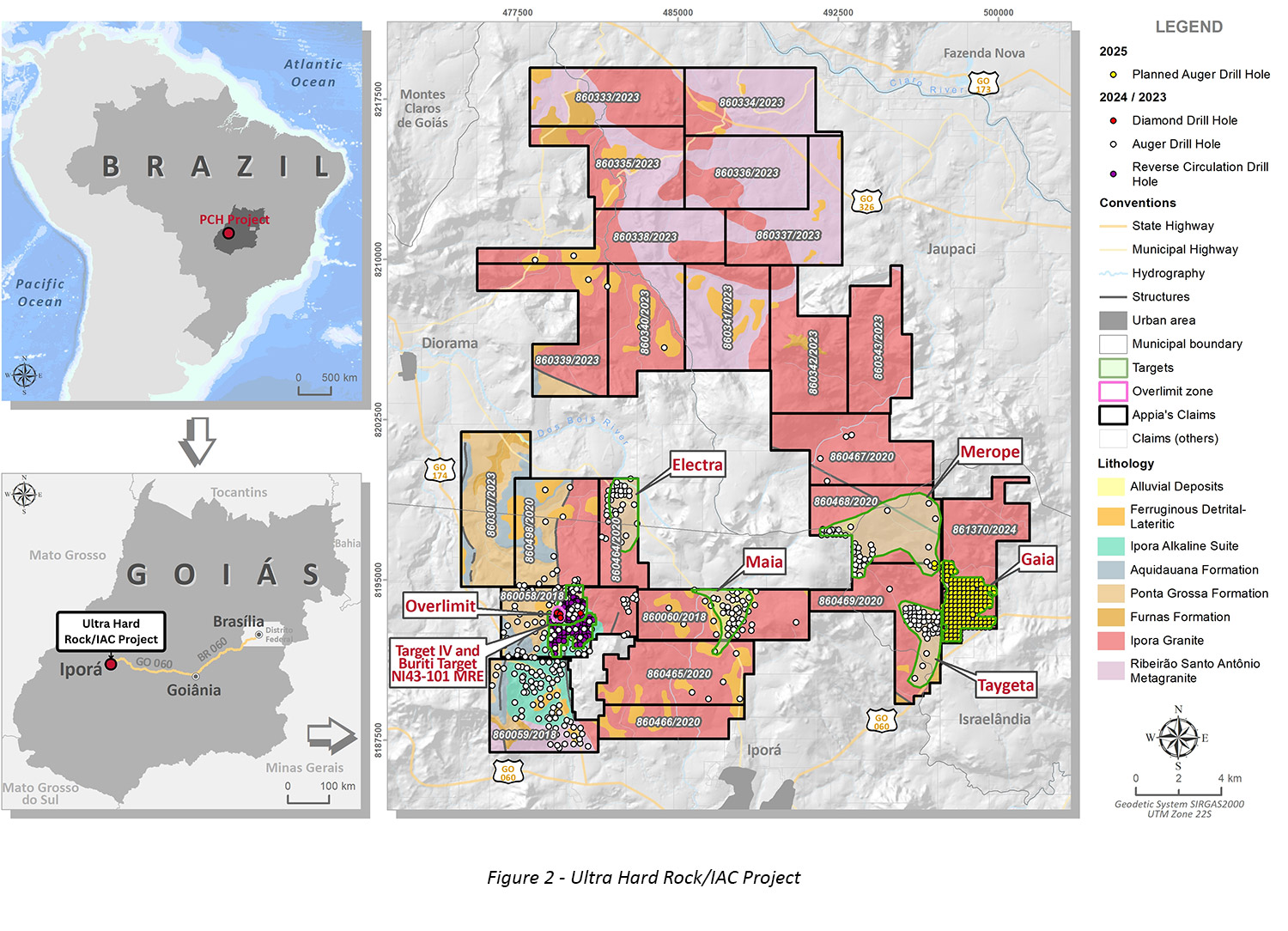
At the Ultra Hard Rock carbonatite target, a 26-hole diamond drilling program totalled 7,347.1 meters. Hole UNA-DDH-015 returned 300 meters grading 2.55% TREO from surface, including 97 meters at 4.52% TREO and 1.7 meters at 14.27% TREO. (See Appia press release dated February 24, 2026) The Ultra IAC Project also has a Mineral Resource Estimate comprising 6.6 million tonnes Indicated grading 2,513 ppm TREO and 46.2 million tonnes Inferred grading 2,888 ppm TREO. (See Appia press release dated April 16, 2024)
Exposure to projects in more than one jurisdiction gives Appia a broader rare earth portfolio, although the ownership structure, geology, technical stage and development considerations differ between Alces Lake and the Ultra projects.
A company’s share price is only one part of the picture when researching Rare Earth Stocks.
Investors may also want to review project ownership, jurisdiction, exploration results, Mineral Resource classification, available funding, planned work and publicly filed technical reports. An exploration company is in a very different position from a company that operates a producing mine.
Appia is a mineral exploration company. It does not operate a producing rare earth mine. Exploration results and targets do not, by themselves, establish a Mineral Resource or Mineral Reserve or guarantee future production. Inferred Mineral Resources are also considered geologically less certain than Indicated Mineral Resources.
The Alces Lake Project remains an important part of Appia’s Canadian rare earth portfolio. In August 2026, Appia reported completing six diamond drill holes totalling 1,440.87 meters across Targets 1, 5 and 7. REE-bearing monazite was visually identified in three of the six holes, and 274 drill-core samples were submitted to the Saskatchewan Research Council for geochemical analysis. (See Appia press release dated August 6, 2026)
The program tested dense rock packages associated with the gravity targets defined by Appia’s 2024 airborne survey and refined through its 2025 ground survey. Samples from the drill holes have been sent to the Saskatchewan Research Council (“SRC”) and results remain pending.
The appeal of Rare Earth Stocks Canada is connected to the potential for Canadian-listed companies to participate in a sector important to permanent magnets, advanced technology and critical-mineral supply chains. That potential must be considered alongside company-specific exploration and market risks.
For Appia, the investment case remains closely tied to exploration progress. Alces Lake provides direct Canadian rare earth exposure, while Appia’s 25% equity interest in Ultra Rare Earth Inc. provides indirect exposure to the Ultra Hard Rock and Ultra IAC Projects in Brazil.
For anyone researching Rare Earth Stocks, the most useful starting point is not simply how much a stock could rise. Reviewing project ownership, technical results, development stage, financial position, public disclosures and planned work provide a more complete picture of both the opportunity and the risks.