
Brazil Rare Earth Projects: Exploring Ionic Clay and Carbonatite Potential
Brazil has become an increasingly interesting destination for rare earth exploration, and Brazil rare earth projects are attracting attention for good reason. The country has a diverse geological landscape, established mining expertise and several different styles of rare earth mineralization. For Appia Rare Earths & Uranium Corp., the opportunity in Goiás is particularly interesting because the project area shows potential for both ionic adsorption clay and hard-rock carbonatite mineralization.
Why Brazil Is Important for Rare Earth Exploration
Brazil has a long history of mining and a large mineral resource base. Brazil also hosts the second largest REE reserves in the world.
One style that has attracted considerable interest is Brazil ionic clay rare earths. Ionic adsorption clay deposits form when weathering breaks down certain rocks and rare earth elements become loosely attached to clay minerals. These deposits can occur relatively close to surface, making them attractive targets for cost-effective mineral exploration.
But ionic clay is not the only story. Brazil also hosts carbonatite-related mineralization, a geological setting that can contain rare earth elements alongside other critical minerals.
This combination is particularly relevant to Ultra’s exploration work in Goiás.
Appia’s Interest in Rare Earth Projects in Goiás
Appia’s Brazilian rare earth opportunity is centred on the Ultra Hard Rock/IAC Projects in Goiás. Appia holds a 25% equity interest in Ultra Rare Earth Inc., which indirectly owns 100% of the Ultra Hard Rock and Ultra IAC Projects in Goiás. The 42,932.24-hectare property contains near-surface clay targets and a hard-rock carbonatite target. (See Appia press release dated June 1, 2026)
The location is another practical advantage. The property is approximately 30 kilometres from Iporá, with access through regional roads, while power and water are available in the area. It is also about 216 kilometres from Goiânia and 410 kilometres from Brasília.
For an exploration project, access matters. Good roads and nearby infrastructure can make field programs easier to organize and can become increasingly relevant if a project progresses through later stages of evaluation.
Brazil Carbonatite Rare Earths: A Second Geological Opportunity
The hard-rock side of the project adds another dimension. Brazil carbonatite rare earths are associated with carbonatite intrusions, which can be important hosts for rare earth mineralization.
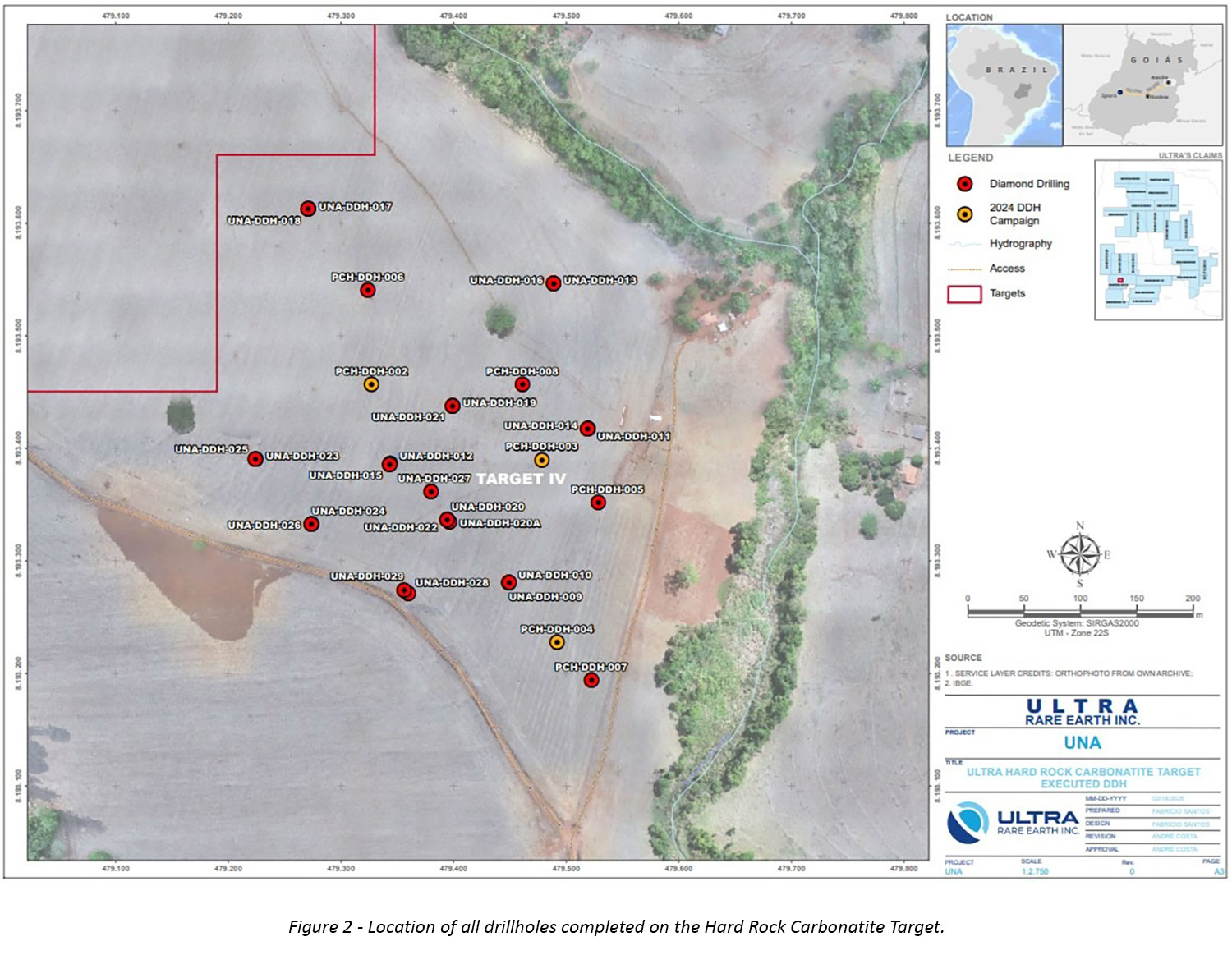
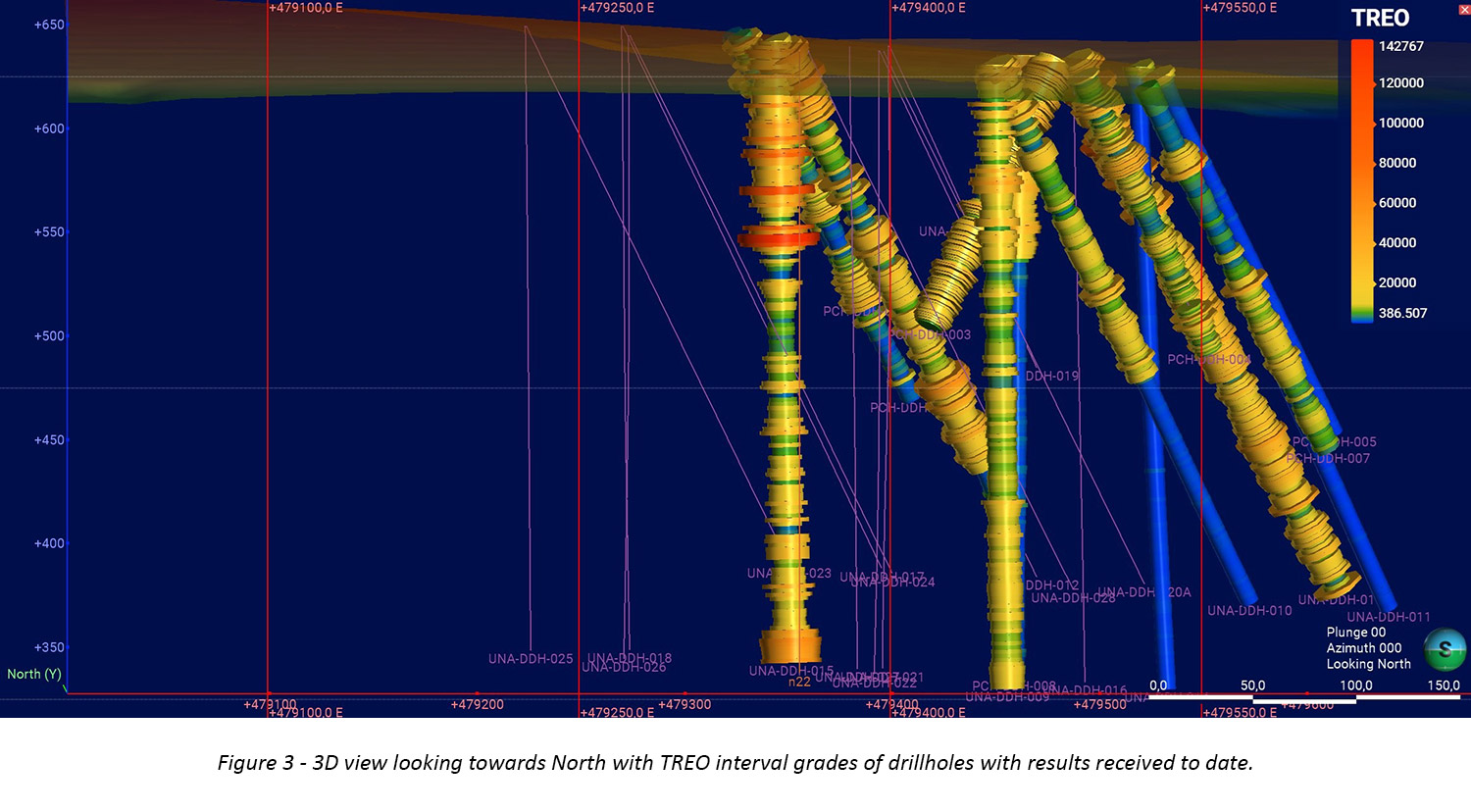
At the Ultra Hard Rock/IAC Project, the most recent drilling at the carbonatite target comprised 26 diamond drill holes totalling 7,347.1 meters and confirmed extensive rare earth mineralization. Highlights included hole UNA-DDH-015, which returned 300 meters grading 2.55% TREO from surface, including 97 meters at 4.52% TREO and 1.7 meters at 14.27% TREO. The results demonstrated continuity of the carbonatite body, which remains open at depth and reappears to the northeast(see press release dated February 24, 2026).(Figure 2, 3).
This creates an unusual combination within one large exploration property. Near the surface, the weathering profile can host ionic clay mineralization, while deeper hard-rock zones provide another avenue for exploration.
The two styles are not simply interchangeable, of course. They have different geological characteristics and would require different approaches to evaluation and potential development. For explorers, however, having both styles present gives the project a broader range of targets to investigate.
What Makes Appia’s Interest in Brazil Rare Earths Interesting?
The story of Appia’s interest in Brazil rare earths is ultimately about exploration potential rather than an operating mine. Ultra is evaluating mineralization and working with Ultra Rare Earth Inc. as the project advances.
The exploration program is also continuing to build on what has already been identified. Ultra is funding a US$6 million program covering both hard-rock and IAC targets, with additional drilling and resource work planned.
Importantly, exploration results should not be confused with a guarantee of future production. A mineral resource is an estimate of material with reasonable prospects for eventual economic extraction under the relevant reporting standards; it does not mean that a mine is currently operating or that commercial production is certain.
What Does This Mean for Canadian Investors?
For Canadian investors, searches for “Canadian rare earth stocks Brazil” reflect interest in Canadian companies with Brazilian rare earth projects and the broader push to diversify critical mineral supplies. Companies listed in Canada can provide investors with exposure to exploration projects outside the country, including opportunities in jurisdictions such as Brazil.
Appia is one example. Its portfolio spans rare earth and uranium projects in Canada as well as its Brazilian rare earth opportunity.
For investors considering Canadian-listed rare earth companies, it is worth looking beyond a project’s headline resource numbers. Ownership structure, exploration stage, project location, infrastructure, mineralization style and the company’s ability to fund future work can all make a difference.
Looking Ahead
The appeal of Brazil rare earth projects is not based on a single type of deposit. Brazil’s varied geology provides opportunities to investigate both weathered ionic clay systems and harder carbonatite-hosted mineralization.
For Appia, the Ultra Hard Rock/IAC Projects offers exposure to both. Continued drilling, sampling and geological work will help determine how these different mineralization styles fit together and how much additional potential remains across the largely underexplored property.
For now, the focus is straightforward: keep exploring, test the strongest targets and build a better understanding of what the geology has to offer. That is where the story of Appia’s interest in Brazil rare earths portfolio currently stands—and where the next stage of exploration could add further clarity.
The technical content in this web page was reviewed and approved by Mr. Don Hains, a Qualified Person as defined by National Instrument 43-101.