
The conversation around Rare Earth Metals in Canada has grown considerably as countries look for dependable sources of the minerals needed for modern technology. Rare earth elements are used in everything from permanent magnets and electric vehicles to wind turbines, electronics and other advanced applications. Canada has the geology, infrastructure and technical expertise to play a larger role in this supply chain, and exploration is an important part of finding out where that potential exists.
Despite their name, rare earth elements are not necessarily rare in the Earth’s crust. The challenge is finding them in concentrations and geological settings that could potentially support economic development.
The group includes 17 elements, each with different characteristics and uses. Some, including neodymium and praseodymium, are particularly important in the manufacture of powerful permanent magnets. These magnets are used in technologies where strong performance in a relatively small size is needed, including electric motors and wind turbines.
That is one reason Rare Earth Elements in Canada have attracted increasing attention. As demand for electrification, advanced manufacturing and other technologies develops, having access to diverse sources of these materials becomes increasingly important.
Canada has a long history of mineral exploration and mining, but rare earth development is a relatively newer part of the country’s critical minerals story. Several exploration projects are being evaluated across the country, with companies investigating different geological settings and types of rare earth mineralization.
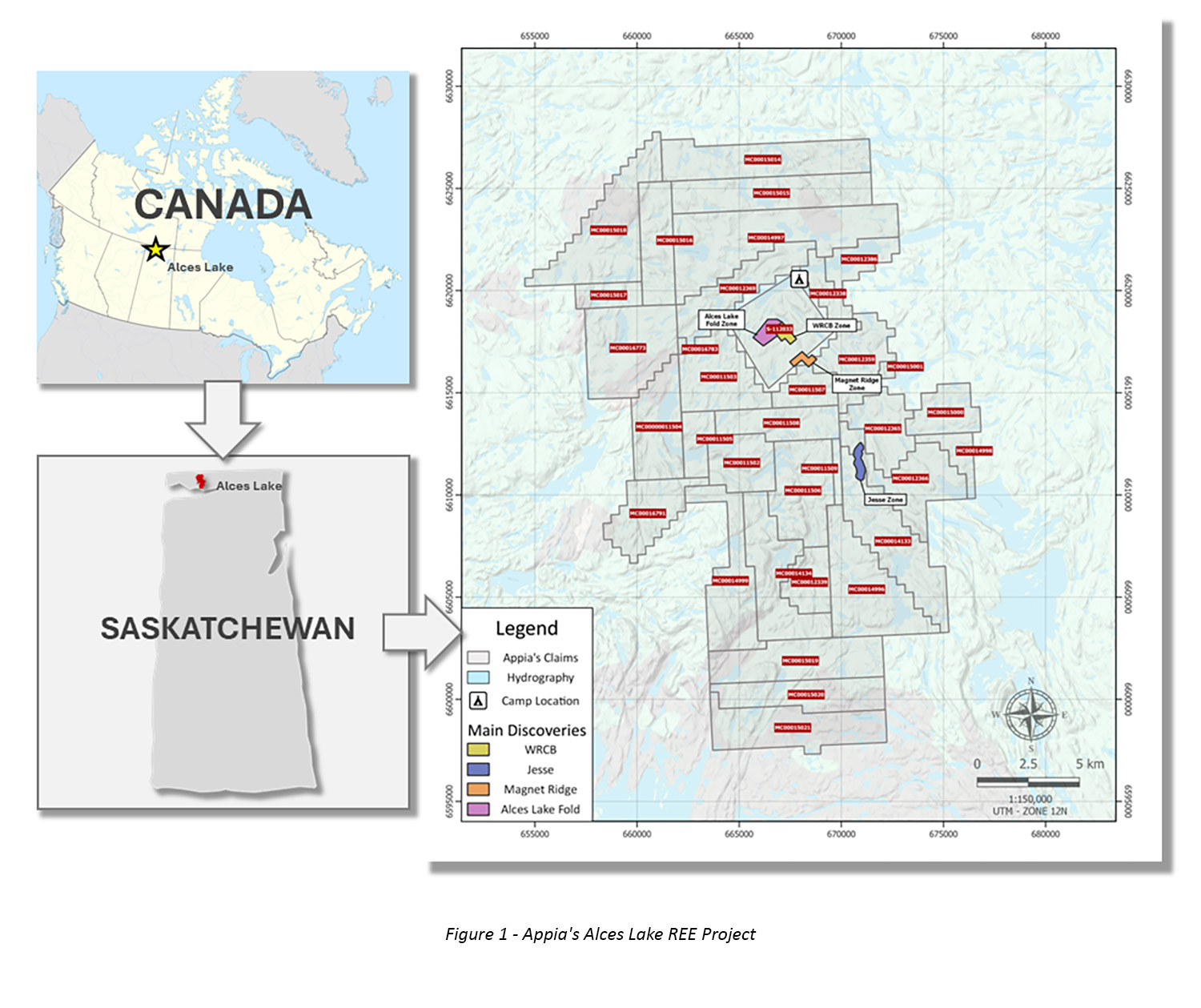
The company’s Alces Lake project in northern Saskatchewan is 100%-owned by Appia and covers approximately 38,522 hectares (Figure 1). Historical drilling at the Ivan Zone returned 16.059 wt.% TREO over 15.55 meters of core length in hole IV-19-012, including 49.165 wt.% TREO over 3.7 meters (see press release dated September 3, 2019).
The project is also notable for its exposure to neodymium and praseodymium, two rare earth elements used in permanent magnet manufacturing. Appia has previously reported that neodymium, praseodymium, dysprosium and terbium accounted for approximately 23% to 25% of the TREO in the Alces Lake mineralization summarized by the company (see press release dated September 3, 2020). Appia’s exploration has included prospecting, geological mapping, sampling, airborne geophysics, ground surveys and drilling to better understand the mineralization across the property.
Finding rare earth mineralization is only the beginning. Exploration is a process of gradually building a better understanding of what is beneath the surface.
At Alces Lake, Appia has been using different geophysical techniques to identify areas that may warrant additional investigation. The approach is fairly straightforward in principle: gather information, identify patterns, test the strongest targets and use the results to guide the next stage of work. In practice, each step can reveal something new about the geology.
This is an important distinction when discussing Rare Earth Mining in Canada. Appia is an exploration company, and its Alces Lake property is an exploration-stage project. Exploration results and mineralized zones should not be treated as proof that a commercial mine will eventually be developed.
A mineral discovery does not automatically become a mine. There can be years of work between identifying promising mineralization and making a decision about whether a project can be developed.
That work may involve additional drilling, resource evaluation, metallurgical testing, engineering studies, environmental assessment, permitting, consultation and financing. The economics of the project also need to make sense at the time development is considered.
For that reason, Rare Earth Mining in Canada should be viewed as the later part of a much longer process. Exploration companies operate at the front end of that process, where the goal is to determine whether a geological opportunity has enough potential to justify further investment.
One notable aspect of Alces Lake is the combination of high-grade mineralization and its location in Saskatchewan. The project is situated in the same provincial jurisdiction as the Saskatchewan Research Council’s rare earth processing facility in Saskatoon, creating a potentially relevant connection between upstream exploration and downstream processing. SRC reported in December 2025 that the facility is expected to become fully operational in early 2027 and is designed to produce 400 tonnes of high-purity NdPr metal annually, with planned capacity increasing to 600 tonnes annually (Source: Saskatchewan Research Council, December 8, 2025).
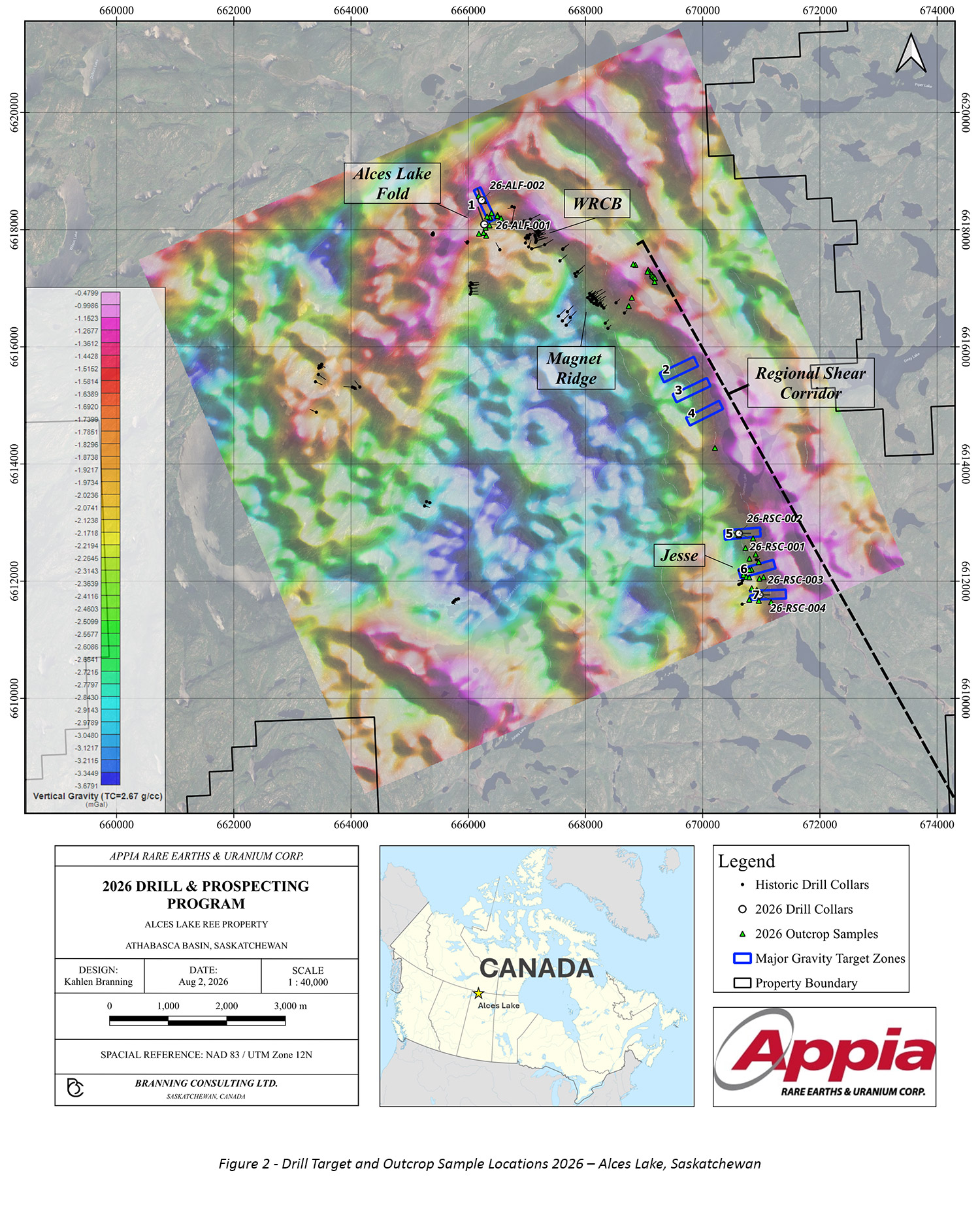
The company has continued to expand its understanding of these areas through geophysical surveys and drilling. In 2026, Appia completed six diamond drill holes totalling 1,440.87 meters across Targets 1, 5 and 7 (Figure 2). REE-bearing monazite was visually identified in three of the six holes, and 274 drill-core samples were submitted to the Saskatchewan Research Council for geochemical analysis. Assay results were pending at the time of the announcement, while three originally planned holes and ten additional targets remained available for future follow-up (see press release dated August 6, 2026).
The potential of Rare Earth Metals in Canada is not simply about having rare earth-bearing rocks in the ground. The bigger question is whether exploration can identify deposits that can eventually be evaluated for responsible and economically viable development.
For Appia, that work is still underway. The company’s focus is on exploring its properties, testing targets and improving its understanding of the mineralization at Alces Lake.
As Canada looks to strengthen its critical mineral supply chains, projects such as Alces Lake demonstrate why exploration matters. The discoveries being investigated today could help shape the country’s rare earth industry in the years ahead, but each project must ultimately be judged on the evidence produced through continued exploration and technical evaluation.