
If you have been following Canada’s mining sector lately, you have probably noticed how often Critical Minerals Canada comes up. There is a good reason for that. Minerals that once received little attention outside the mining industry are now closely connected to electric vehicles, renewable energy, electronics and other technologies.
Rare earth elements are part of this conversation. Canada has a long history of mineral exploration, and companies are now looking more closely at areas that could contain the materials needed for these growing industries.
Strategic metals are usually referred to as critical for key industries and when it comes to supply, they pose threats. A mineral doesn’t always have to be very uncommon to be strategically significant. The important thing is how challenging it might be to obtain and how much it is needed by modern industries.
Rare earth elements are an example. The rare earth group contains 17 elements with a variety of uses. Some are especially useful for being made into strong permanent magnets. These magnets are found in electric motors, wind turbines, electronics and other technologies where compact, high-performance components are needed.
That growing demand is one reason exploration for rare earth minerals Canada has received more attention.
Canada has several areas with rare earth exploration potential, including Saskatchewan. The province is already well known for its uranium industry, but rare earths are becoming another interesting part of its mineral story.
Appia Rare Earths & Uranium Corp. is exploring its Alces Lake property in northern Saskatchewan. The company owns 100% of the project, which covers approximately 38,522 hectares. Exploration has identified monazite-hosted rare earth mineralization, including high-grade mineralization at surface and near surface. Reported samples have returned grades including 49.17 wt.% total rare earth oxides (TREO), see September 3, 2019 NR.
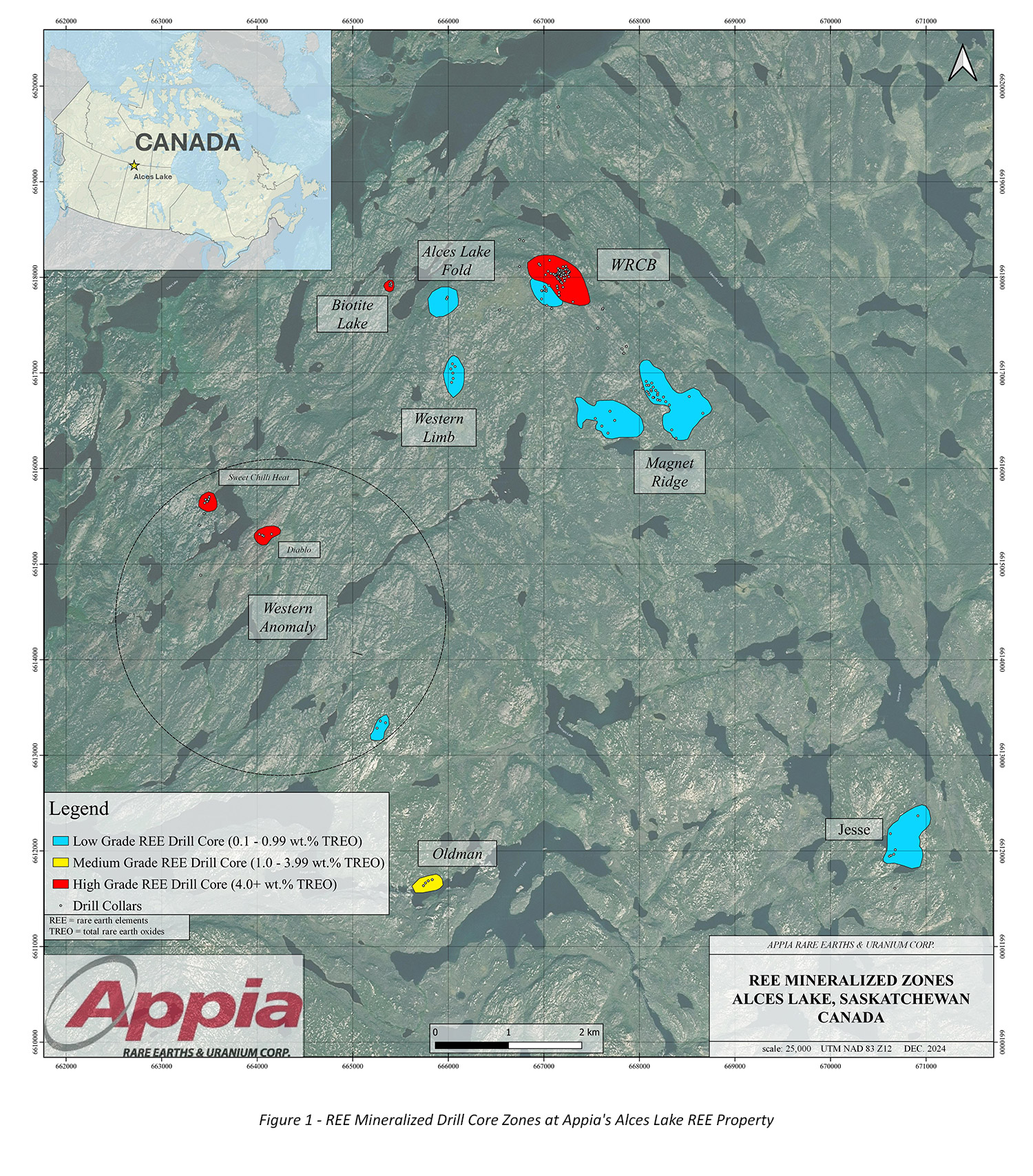
The property contains several areas of interest, including the WRCB Zone, Magnet Ridge, the Western Anomaly and the Jesse Zone, all of which showing rare earth element mineralization on the property (Figure 1). Appia has used geological work, sampling, geophysical surveys and drilling to learn more about these areas and identify additional targets.
What makes Alces Lake particularly interesting is the range of rare earth elements being investigated there. The project includes neodymium and praseodymium, as well as heavy rare earth elements such as dysprosium and terbium.
These elements have practical applications. Neodymium and praseodymium, for example, are important components of high-performance permanent magnets. Dysprosium and terbium can also be used in magnet applications where performance at higher temperatures is important.
The project’s location is another point worth noting. Alces Lake is in Saskatchewan, where the Saskatchewan Research Council has been developing rare earth processing capabilities. That does not mean an exploration project automatically becomes a mine, but having mineral exploration and processing initiatives in the same province is relevant to Canada’s longer-term efforts to develop its critical mineral supply chain.
The interest in Critical Minerals Canada is really about what the country may need in the years ahead. As technologies become more dependent on specialized materials, having reliable sources closer to home can become increasingly valuable.
For explorers, that creates an opportunity—but also a lot of work. At Alces Lake, Appia continues to test targets and gather information about the property’s rare earth potential. In 2026, Appia completed its summer drilling program at the Alces Lake REE Property in northern Saskatchewan, drilling six holes totalling 1,440.87 metres across three priority targets. REE-bearing monazite was visually identified in three holes, and 274 drill-core samples were submitted to the Saskatchewan Research Council for analysis. (Source: Appia press release, August 6, 2026)
For now, the story is still one of exploration. Appia is working to understand what is beneath the ground at Alces Lake and whether the mineralization identified so far can support further development.
As Canada’s critical minerals sector continues to take shape, projects like Alces Lake are an important reminder of where it all starts: with exploration, geological evidence and the search for resources that could eventually support future industries.