
Ultra Hard Rock/IAC Project

Goiás, Brazil

Actual Picture of the Ultra Hard Rock/IAC Project

Overview

The Rare Earth Potential of the Ultra Hard Rock/IAC Project

Exploration work, led by Ultra Rare Earth Inc., is continuing to improve the knowledge of the rare earth mineralization styles on its Ultra Hard Rock/IAC Project, including both near-surface Ionic Adsorption Clay (IAC) mineralization and hard-rock carbonatitic breccia mineralization.

Ultra is funding a total of US$6 million to advance the Project, including hard-rock and IAC targets (See press release dated June 12, 2024). Appia currently holds a 25% interest in the Project, and Ultra intends to consolidate 100% at the PFS stage, with Appia expected to exchange its project interest for equity consideration in Ultra at that time.

The initial MRE, based on 147 Reverse Circulation (RC) drill holes and one Diamond Drill Hole (DDH), was released in March 2023 (See press release dated March 1, 2024). The Rare Earth Mineral Resource was estimated at 6.6 Million Tonnes Indicated grading 2,513 ppm TREO and 46.2 Million Tonnes Inferred grading 2,888 ppm TREO.

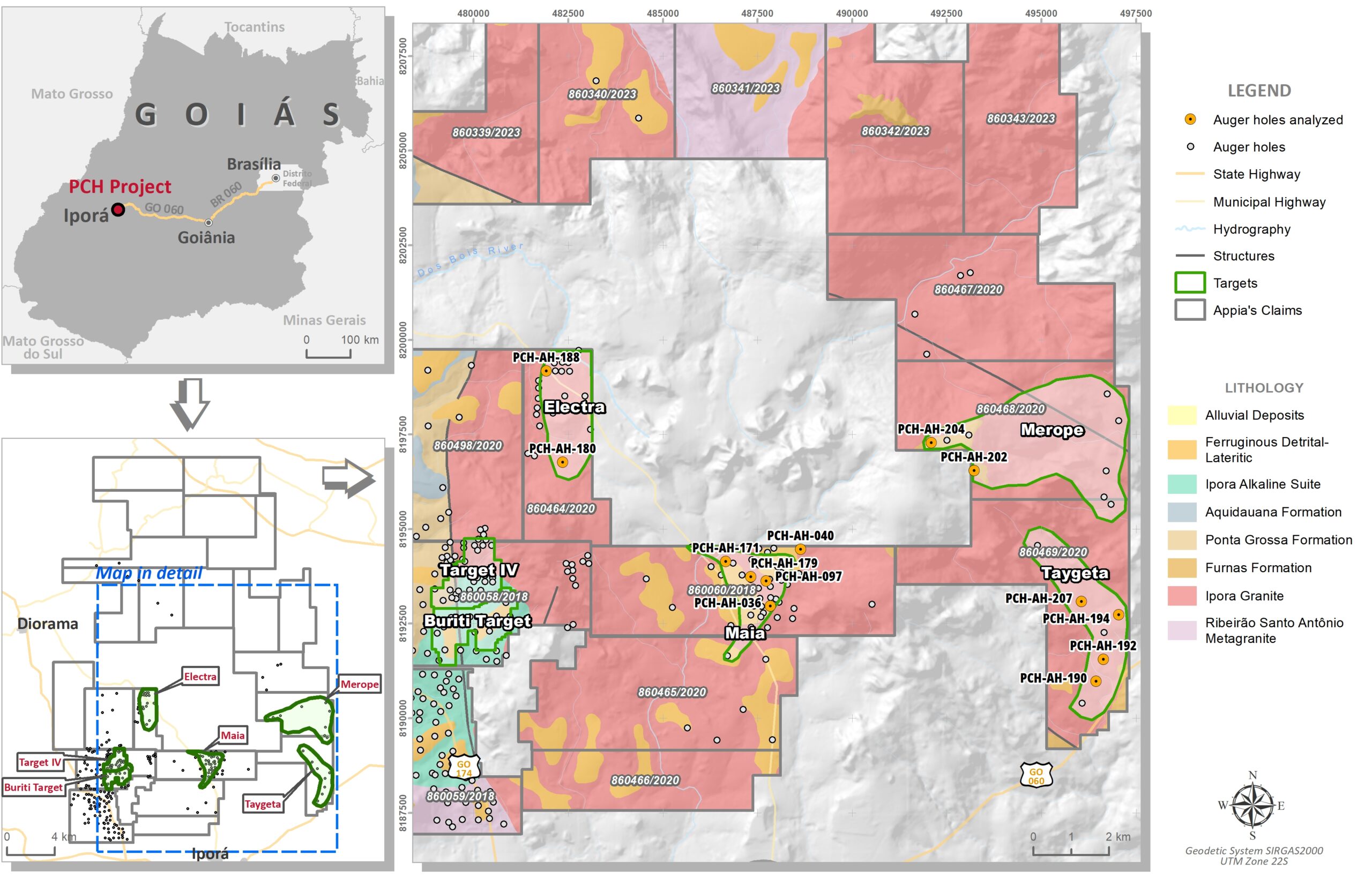
Encouraging Rare Earth Oxides (REO) recoveries on new targets identified (See press release dated August 20, 2024). The results from these new targets, named Maia, Electra, Taygeta and Merope, are encouraging. Additional exploratory Auger drilling work and sampling is being carried out on these new IAC zones identified on the Iporá Granite geological unit.

Location

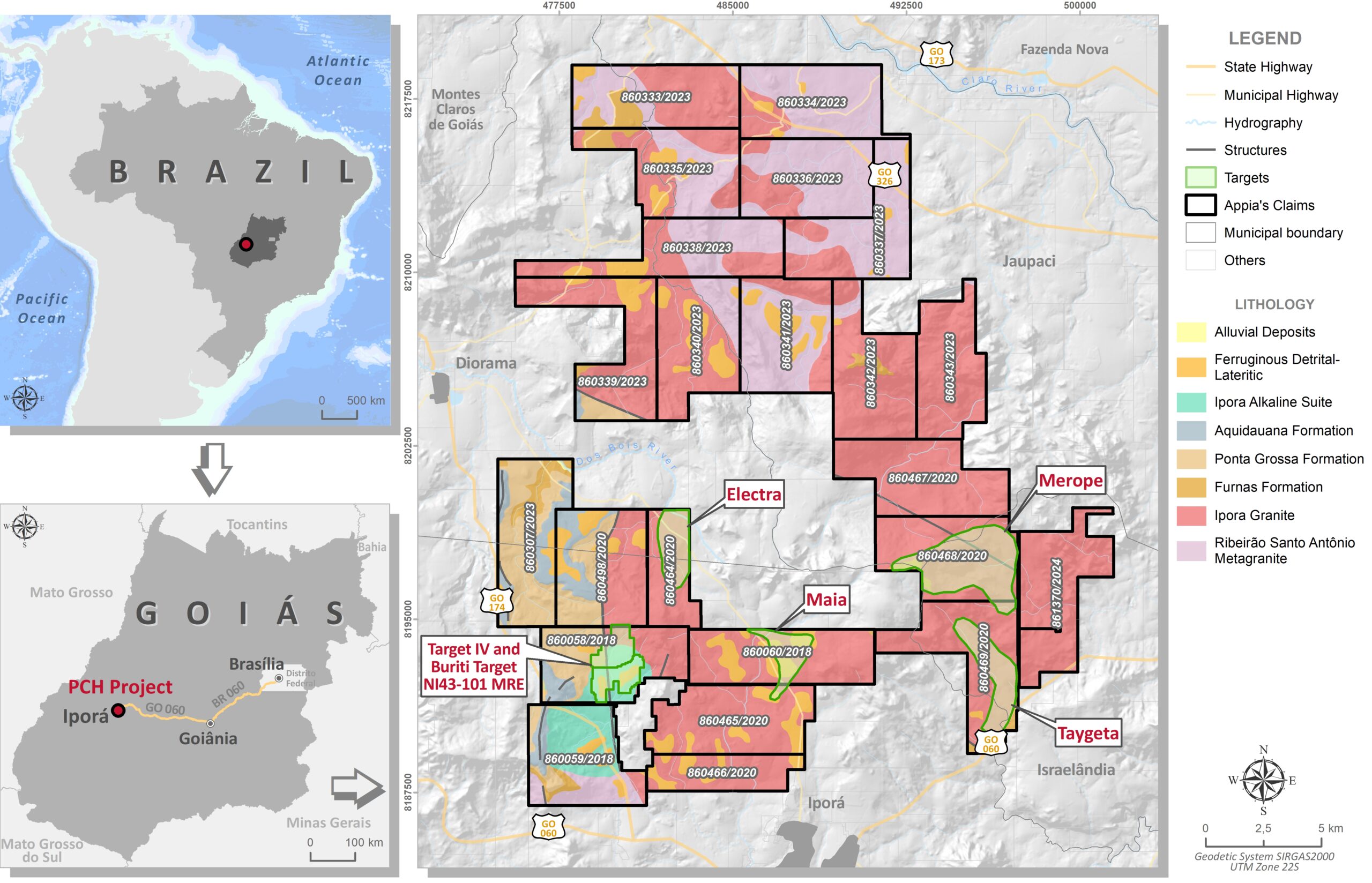
Situated in the heart of Goiás state, Brazil, the Ultra Hard Rock/IAC Project offers a strategic location just 216 km from Goiânia, the state capital, and a mere 410 km from Brasília, the nation’s capital. The project is conveniently positioned approximately 30 km from Iporá, a vibrant mid-size city with a population of around 31,500, as per the 2018 census, ensuring easy access to a skilled labour pool.


Accessing the property from Iporá is ideal, due to a well-developed network of regional roads. These roads offer a blend of hard and gravel surfaces, ensuring smooth and reliable transportation. Within the property boundaries, exists a well-maintained network of gravel-surfaced rural roads and unsurfaced farm roads that provide excellent project accessibility.


In addition to its strategic location, the presence of power and water adds to the project’s economic significance and underscores the potential for long-term resource extraction. The project is well-equipped to harness these resources while maintaining environmental responsibility and compliance with relevant regulations.


Furthermore, the property holds the promise of yielding valuable niobium and scandium resources, providing a multifaceted opportunity for growth and resource recovery.

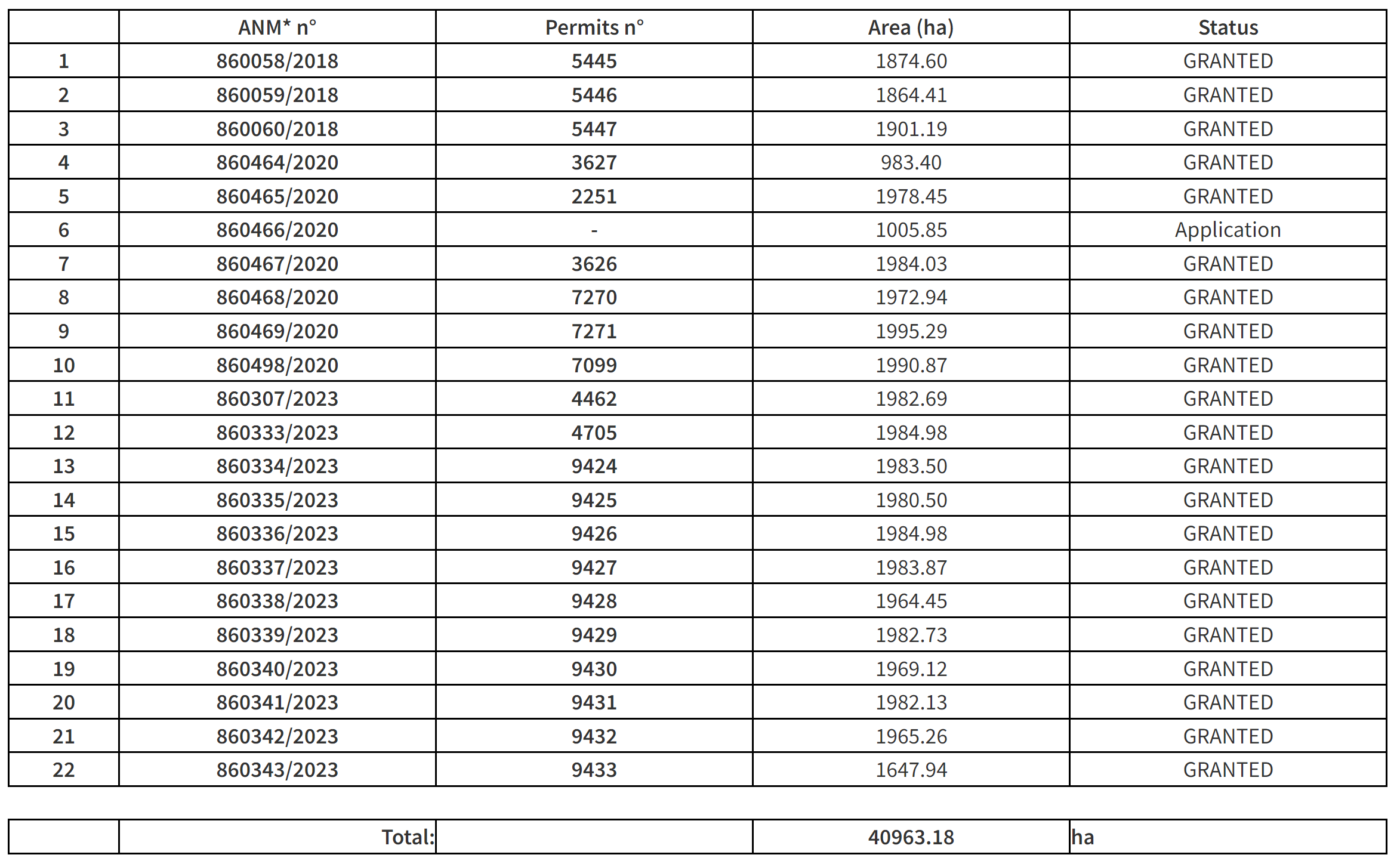
The PCH Ionic Adsorption Clay REE project boasts 23 claims over a total area of 42,932 hectares, strategically located within a prime mineralization zone. Only ~20 of the property has been explored to-date.

Ionic Adsorption Clay Mineralization

  • The New IAC zones identified (Merope, Taygeta, Maia and Electra) are being drilled using auger and assayed to test the grades and desorption result.
  • There is potential for an additional 403 million tonnes of material.
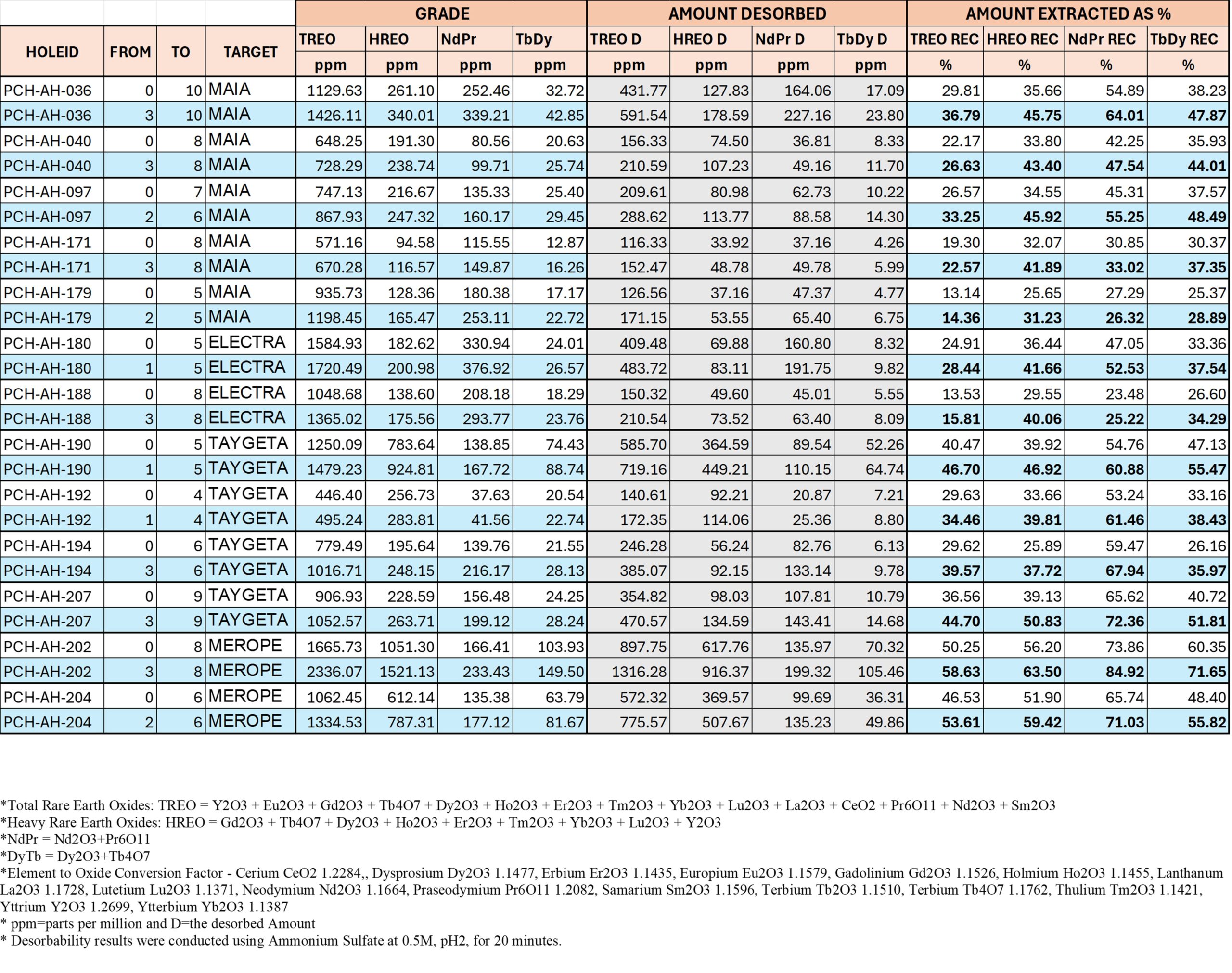
  • Desorbability results were conducted using Ammonium Sulfate at 0.5M, pH2, for 20 minutes. ( See press release dated August 20, 2024).
  • Desorbability testing at pH4 is currently underway.

The IAC style of mineralization is related to the Ipora Granite, and Phase II exploratory auger drilling is under way. Preliminary recovery results include:

Maia

  • TREO – up to 36.79%
  • HREO – up to 45.9%
  • NdPr – up to 64.01%
  • DyTb – up to 48.49%

Merope

  • TREO – up to 58.63%
  • HREO – up to 63.50%
  • NdPr – up to 84.92%
  • DyTb – up to 71.65%

Electra

  • TREO – up to 28.44%
  • HREO – up to 41.66%
  • NdPr – up to 52.53%
  • DyTb – up to 37.54%

Taygeta

  • TREO – up to 46.70%
  • HREO – up to 50.83%
  • NdPr – up to 72.36%
  • DyTb – up to 55.47%
Click Map to Enlarge

High-Grade Mineralization

High-Grade Mineralization Potential (Target IV – “Overlimit” Zone):

  • 10 Reverse Circulation (RC) holes returned a total weighted average of 7,578 ppm (0.76% TREO).
  • The high-grade zone, located in the west portion of Target IV, presents high TREO grades up to 92,000 ppm TREO, averaging approximately 23,000 ppm TREO in its inner core, and is associated with a carbonatitic breccia intrusion/dike.
  • Recent drilling has confirmed significant hard-rock thickness and grade, including 147 m @ 2.0% TREO, with higher-grade internal intervals reported up to ~5.68% TREO, and potential Nb₂O₅ and P₂O₅ by-product credits.
  • Approximately 20% of assays returned “overlimit”, and these intervals are being re-assayed to refine reported grades.
  • The carbonatite remains open at depth, with all three diamond drillholes ending in mineralization, supporting strong down-plunge/vertical continuity (See press release dated October 23, 2024).
  • Three drills are currently active (as of Q4 2025), targeting an additional ~20–24 holes to expand and better define the high-grade carbonatite system and its extensions.
  • Next steps include additional diamond drilling, expanded IAC drilling (auger/RC), and ongoing metallurgy/mineralogy work to support updated NI 43-101 resources for both IAC and carbonatite mineralization and to advance the IAC zones toward PFS.
Drillhole Thickness TREO% Nb205% From
PCH-DDH-002 150 metres @ 1.34% 0.13% Surface
including 10 metres @ 4.11% 0.23% 37 metres
including 10 metres @ 2.24% 0.17% 91 metres
including 6 metres @ 3.94% 0.22% 144 metres
PCH-DDH-003 147 metres @ 2.00% 0.23% Surface
including 31 metres @ 3.60% 0.53% 3 metres
including 8 metres @ 3.68% 0.31% 47 metres
including 9 metres @ 2.35% 0.11% 117 metres
PCH-DDH-004 153 metres @ 1.32% 0.20% Surface
including 9 metres @ 3.01% 0.26% 11 metres
including 10 metres @ 5.68% 0.44% 42 metres
including 22 metres @ 1.13% 0.44% 138 metres
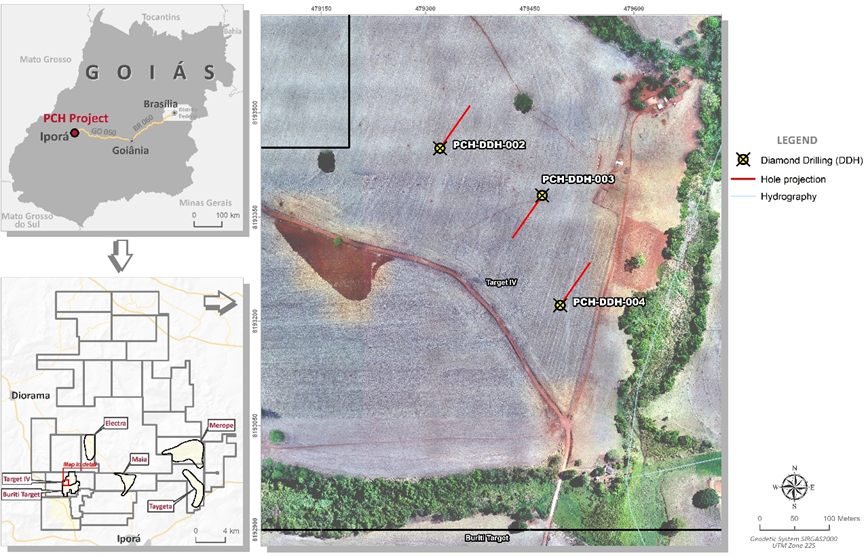
*Map of programmed Diamond Drillholes.
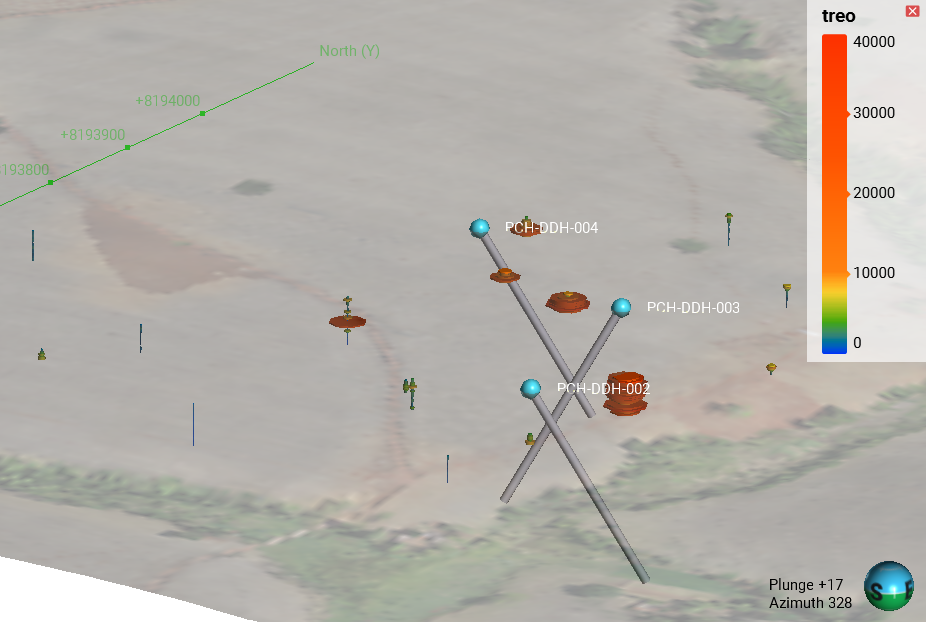
*3D view of Programmed DDH location and TREO high-grade auger hole intercepts.

Maiden Mineral Resource Estimate

The Mineral Resource Estimate (MRE) for the project has been scheduled with an effective date of February 1, 2024. It is authored by Mr. Yann Camus, P.Eng., a professional engineer employed by SGS, and adheres to the current Standards on Mineral Resources and Reserves, Definitions, and Guidelines set by the Canadian Institute of Mining, Metallurgy and Petroleum (CIM). The report clarifies that Mineral Resources which are not classified as Mineral Reserves do not currently show economic viability, and emphasizes that further exploration and additional drilling will be necessary to upgrade Inferred and Indicated Mineral Resources to Measured Mineral Resources. It also notes the inherent uncertainty in converting any part of Mineral Resources into Reserves.

The analytical processes used for the MRE were conducted by SGS GEOSOL using methods such as ICM40B, which involves Multi Acid Digestion combined with ICP OES and ICP MS, and IMS95R, which uses Lithium Metaborate Fusion followed by ICP-MS. The MRE is defined with a cut-off Net Smelter Return (NSR) value of $10 per tonne. Details on the full price list and recovery methods used for NSR estimation are included in Table 2, which also lists an estimated basket price for Total Rare Earth Oxides (TREO) at $26.98.

For optimizing the mining operation, GEOVIA’s WhittleTM software was utilized to outline an optimal pit envelope, indicating reasonable prospects for economic extraction. The preliminary pit optimization includes parameters such as a 30-degree overall pit slope, mining costs of $2.10 per tonne, processing and general/administrative costs of $9 per tonne, and accounts for a total mining loss and dilution of 5%. Further specifics of these parameters are also provided in Table 2, where forward-looking prices for the basket and oxides are based on market trends and economic forecasts, although actual prices may vary due to changes in these factors.

The report also addresses the calculation of bulk densities, which were determined through physical test work and assumptions about porosities for each type of material. Definitions for categories of oxides like Total Rare Earth Oxides (TREO), Magnetic Rare Earth Oxides (MREO), and Heavy Rare Earth Oxides (HREO) are detailed, listing the specific oxides included in each category. Finally, the report warns that the MRE might be significantly impacted by various external factors including environmental, permitting, legal, title, taxation, socio-political, marketing, or other relevant issues, emphasizing the complex nature of resource estimation.

Project News

Appia Issues 500,000 Shares and Earns Further Interest in the PCH Project

Appia Announces Exceptional Overlimit Total Rare Earth Oxide (TREO) Results From Its Diamond Drilling Program at PCH Project in Goias, Brazil

Appia Announces Excellent Desorption Results From Its Four New Ionic Adsorption Clay Targets at the PCH Project in Goias, Brazil

Subscribe