The Rare Earth Potential of the Ultra Hard Rock/IAC Project
The Ultra Hard Rock/IAC Project in Goiás, Brazil is a large-scale dual-style rare earth opportunity with exposure to both ionic adsorption clay and hard rock carbonatite mineralization. Covering approximately 42,932 hectares, the Project offers investors exposure to a maiden NI 43-101 Mineral Resource Estimate, strong NdPr and heavy rare earth distribution, and meaningful exploration upside with only about 20% of the property tested to date.
The Project stands out for its combination of scale, growth potential, and development flexibility. Its ionic clay mineralization supports low-capex, scalable potential, while the hard rock component adds further opportunities as drilling advances.
The Project is currently being advanced through a US$6 million program by Ultra Rare Earth Inc. (“Ultra”), including completed diamond drilling and a larger 2026 RC and auger campaign, with a further Mineral Resource Estimate and Pre-Feasibility Study planned for 2026.
Appia currently has a 25% interest in Ultra, providing shareholders with continued exposure to a growing asset in the global rare earths sector.
Location
Situated in the heart of Goiás State, Brazil, the Ultra Hard Rock/IAC Project is strategically located approximately 216 km from Goiânia, the state capital, and 410 km from Brasília, the capital of Brazil. The Project is also located approximately 30 km from Iporá, a regional centre that provides access to labour, services, and infrastructure.
Access to the Project is supported by a well-developed network of regional roads, including hard-surfaced and gravel roads, allowing for efficient transportation to and within the property. Existing gravel-surfaced rural roads and farm roads provide strong internal access throughout the Project area.
The Project also benefits from access to power and water, which may support future development scenarios. In addition to its rare earth potential, the property has also shown potential for associated niobium and scandium mineralization, providing additional upside.
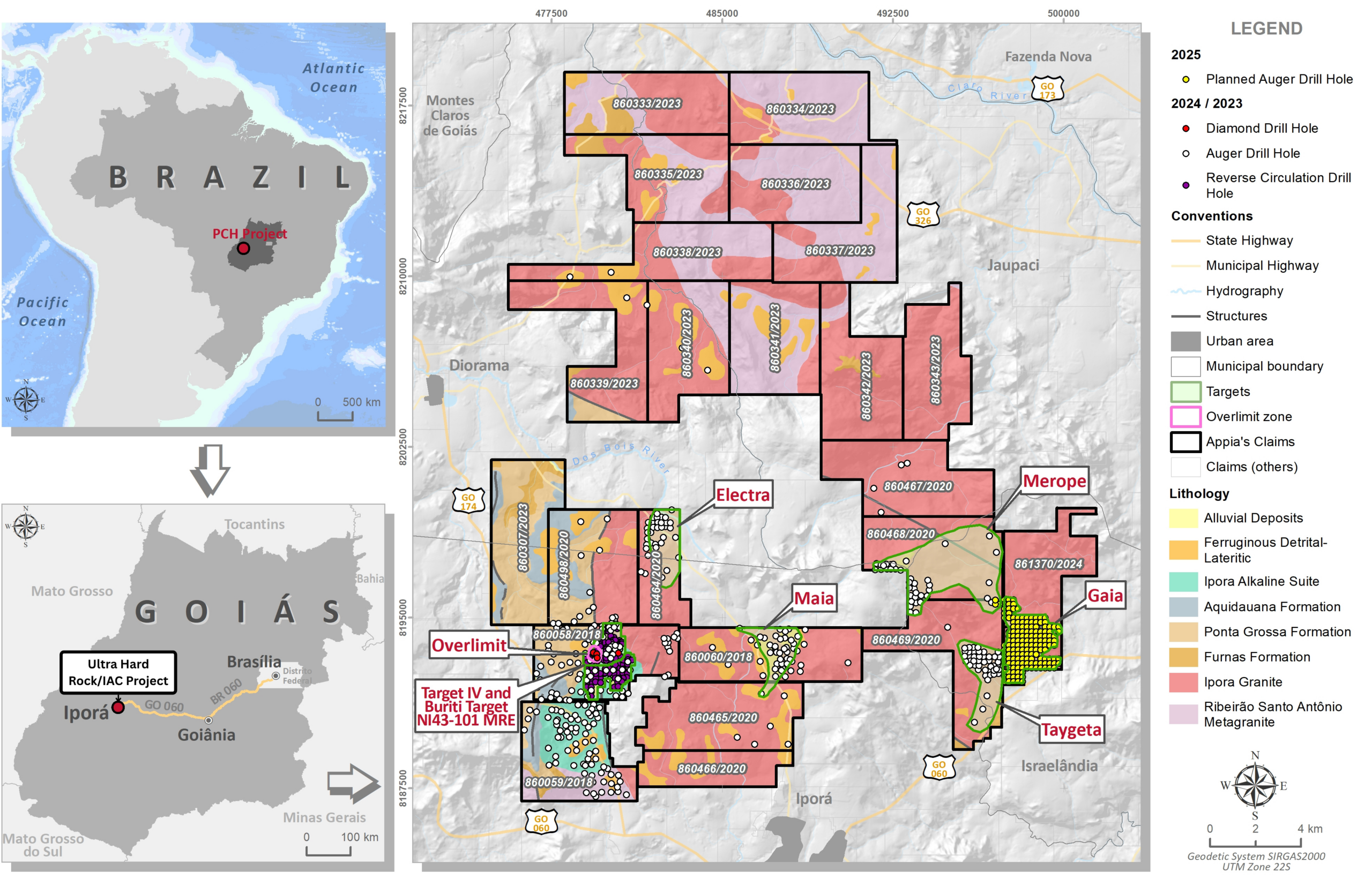
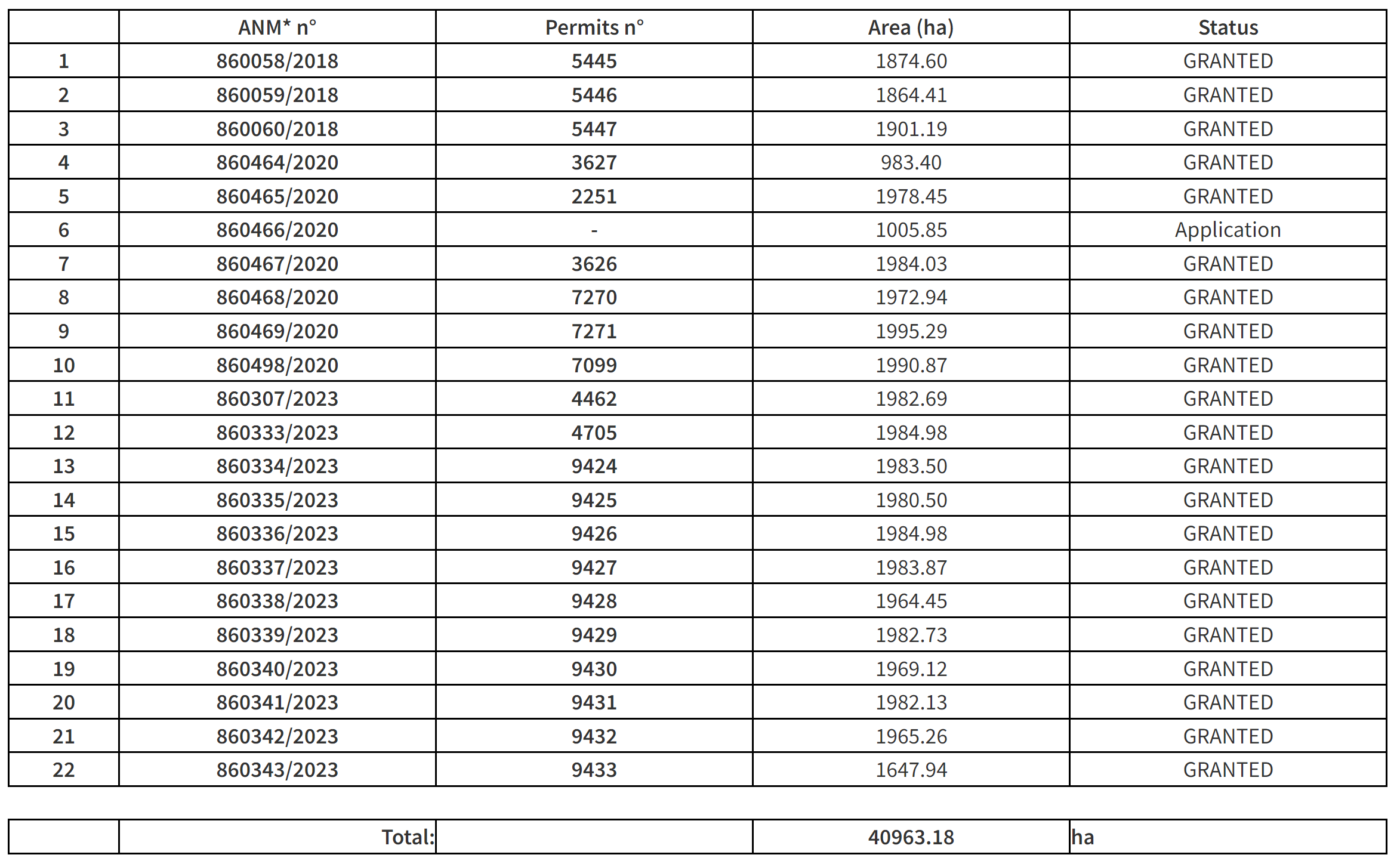
The Ultra Hard Rock/IAC Project comprises 23 claims covering a total area of 42,932 hectares within a highly prospective mineralized corridor. With only a limited portion of the total property tested so far, the Project continues to offer meaningful exploration upside.
The Ultra Hard Rock/IAC Project Ionic Adsorption Clay REE project boasts 23 claims over a total area of 42,932 hectares, strategically located within a prime mineralization zone. Only ~20% of the property has been explored to-date.
Diamond drilling at the Ultra Hard Rock/IAC Project continues to confirm a large, high-grade rare earth system with long mineralized intervals starting at surface. Assay results received to date from 13 drill holes show broad TREO mineralization, including several higher-grade zones that support the scale and strength of the carbonatite target (please refer to Appia’s press release dated Feb.24, 2026). Additional results from the remaining 13 drill holes will be public soon.
Highlighted drill results include:
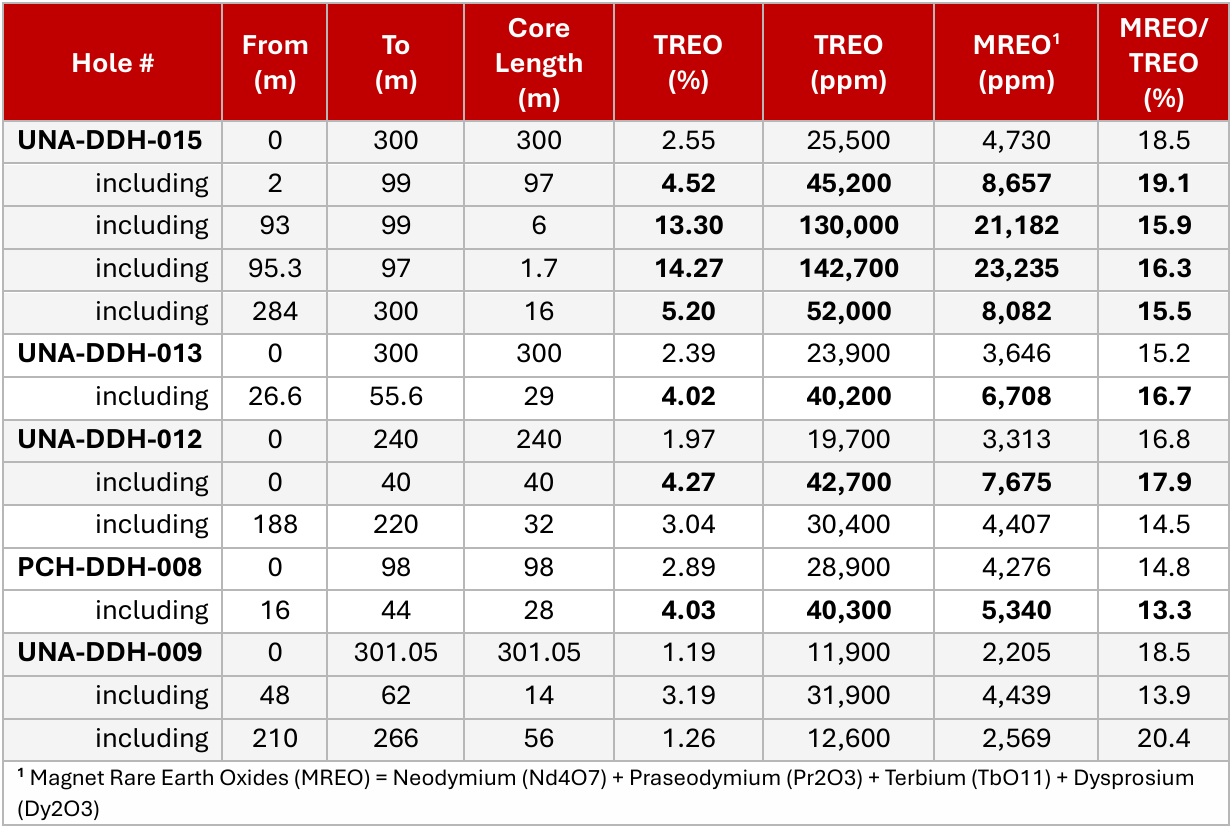
UNA-DDH-015:300 metres at 2.55% TREO from surface, including 97 metres at 4.52% TREO, 6 metres at 13.30% TREO, and a standout interval of 1.7 metres at 14.27% TREO from 95.3 metres. This hole also returned 16 metres at 5.20% TREO near the bottom of the interval.
UNA-DDH-013:300 metres at 2.39% TREO from surface, including 29 metres at 4.02% TREO.
UNA-DDH-012:240 metres at 1.97% TREO from surface, including 40 metres at 4.27% TREO from surface and 32 metres at 3.04% TREO at depth.
These results show both strong grades and meaningful thickness, with mineralization beginning at or near surface in several holes. The table also shows encouraging Magnet Rare Earth Oxide (MREO) values, including neodymium, praseodymium, terbium, and dysprosium, which are the rare earths most closely tied to permanent magnet demand.
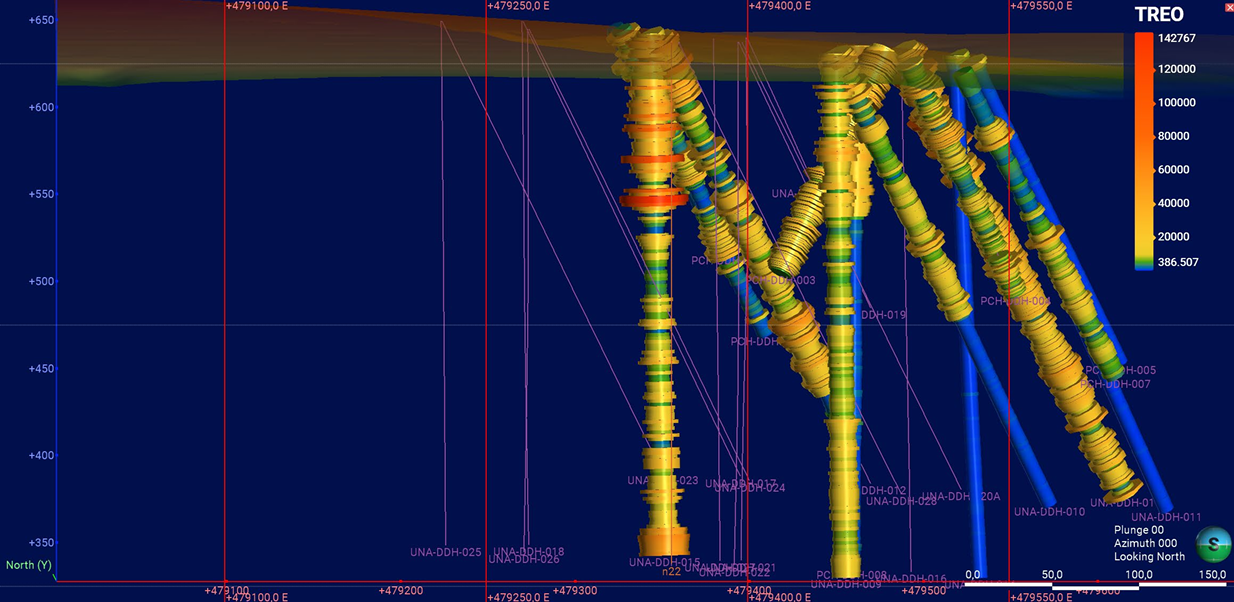
The drillholes have reached depths of up to 300 metres, helping define most of the carbonatite intrusion, while the results received so far clearly outline the mineralized body. Appia also notes that mineralization remains open at depth and reappears to the northeast, indicating room for further growth as additional assays are received and drilling continues.
Drillhole
Thickness
TREO%
Nb205%
From
PCH-DDH-002
150 metres
@
1.34%
0.13%
Surface
including
10 metres
@
4.11%
0.23%
37 metres
including
10 metres
@
2.24%
0.17%
91 metres
including
6 metres
@
3.94%
0.22%
144 metres
PCH-DDH-003
147 metres
@
2.00%
0.23%
Surface
including
31 metres
@
3.60%
0.53%
3 metres
including
8 metres
@
3.68%
0.31%
47 metres
including
9 metres
@
2.35%
0.11%
117 metres
PCH-DDH-004
153 metres
@
1.32%
0.20%
Surface
including
9 metres
@
3.01%
0.26%
11 metres
including
10 metres
@
5.68%
0.44%
42 metres
including
22 metres
@
1.13%
0.44%
138 metres
*Map of completed diamond drillholes.
*3D view of completed DDH and TREO high-grade diamond drill hole intercepts
*TREO highlights from the initial 13 diamond drill hole results
Ionic Adsorption Clay Mineralization
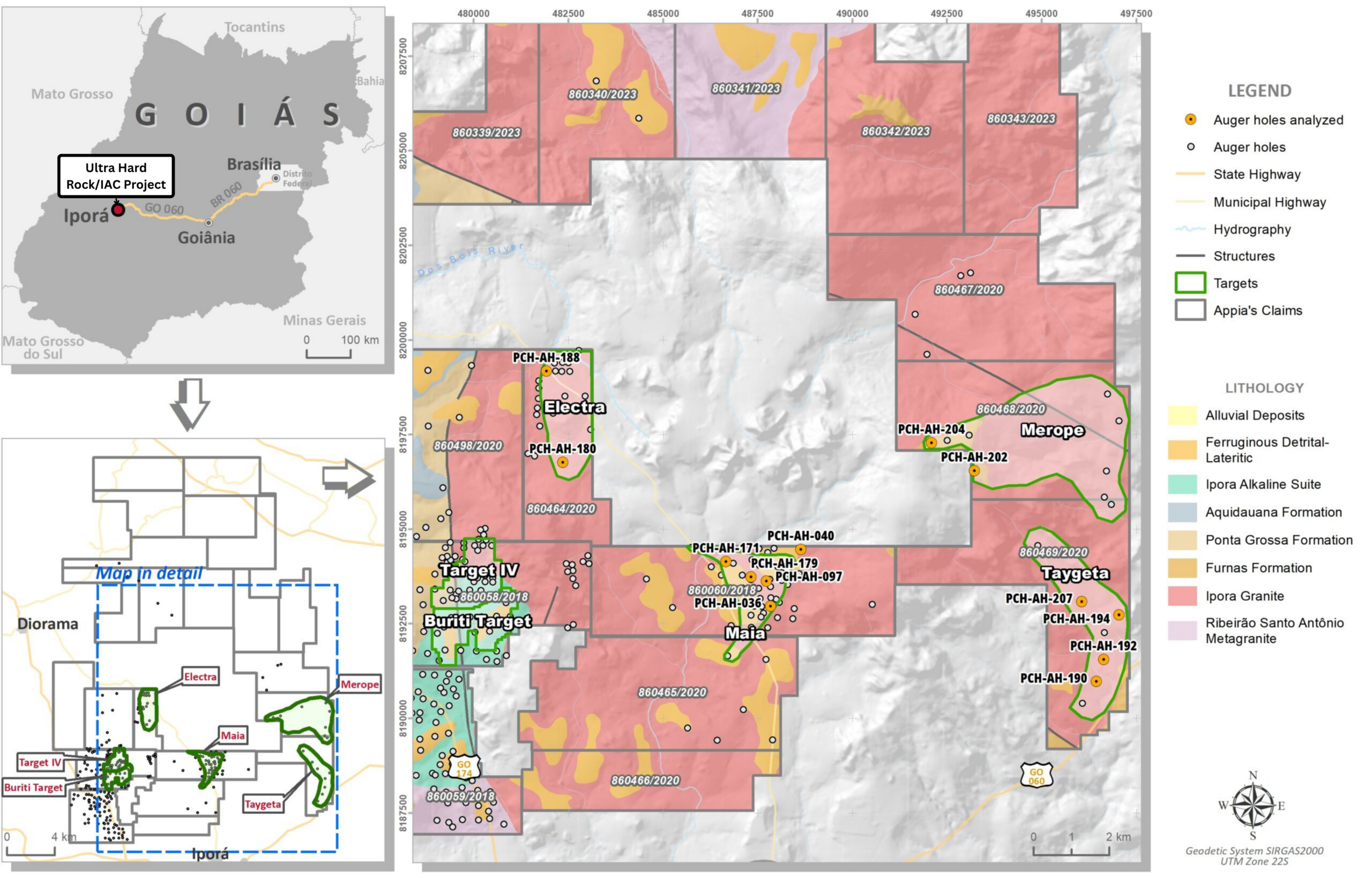
The Project includes multiple Ionic Adsorption Clay targets that continue to be advanced through auger drilling, sampling, and desorption testing. Newly identified IAC zones, including Merope, Taygeta, Maia and Electra, are being tested to better define grade distribution and recovery characteristics. A Mineral Resource Estimate has been completed on the ionic clay discoveries (link below), with an additional MRE and a prefeasibility study planned for 2026.
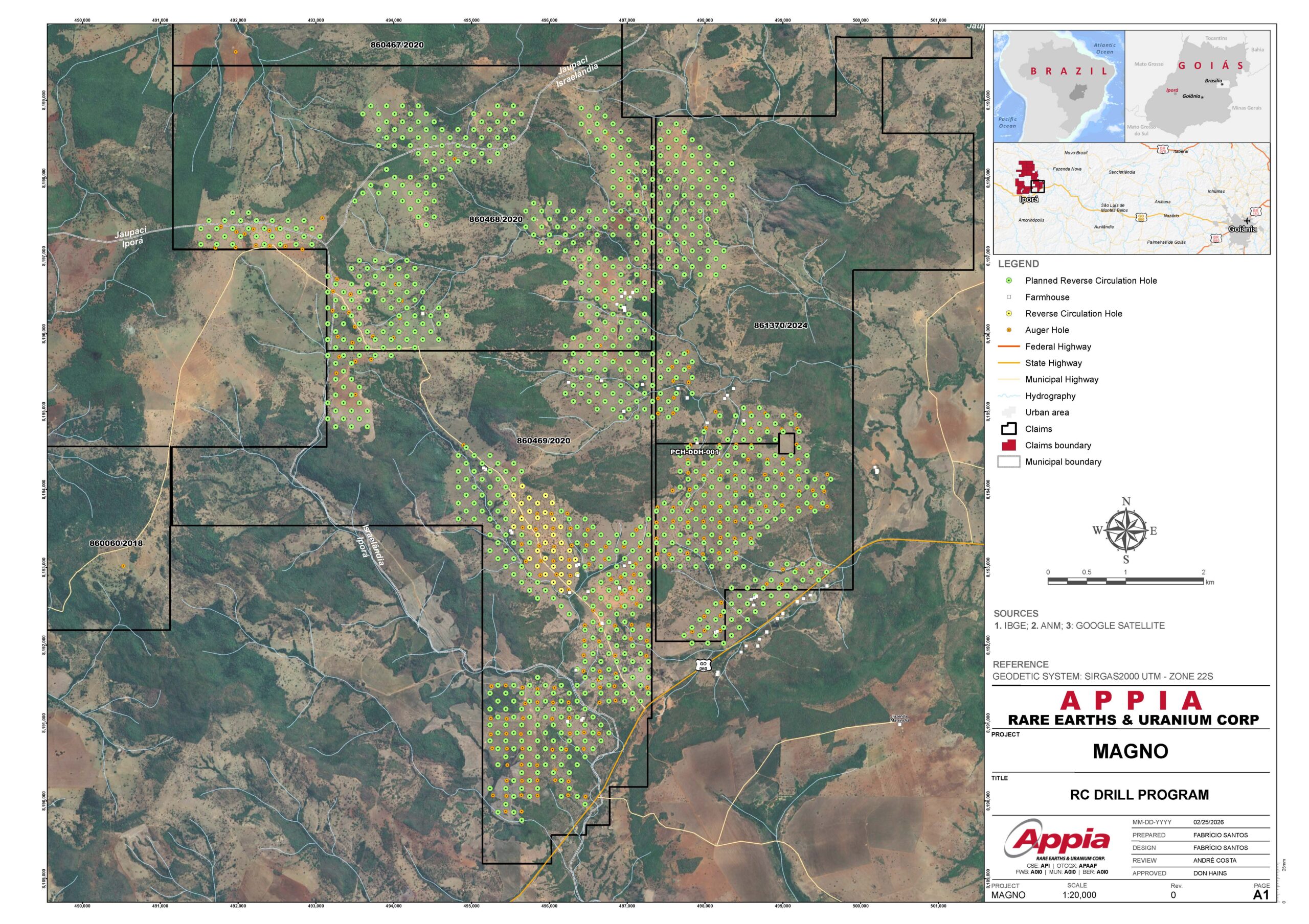
These new IAC zones are interpreted to be associated with the Iporá Granite. As of 2026, Appia currently has 4 RC and 2 auger drills expanding the IAC discovery, with 952 planned RC holes and as many auger holes as possible across the property.
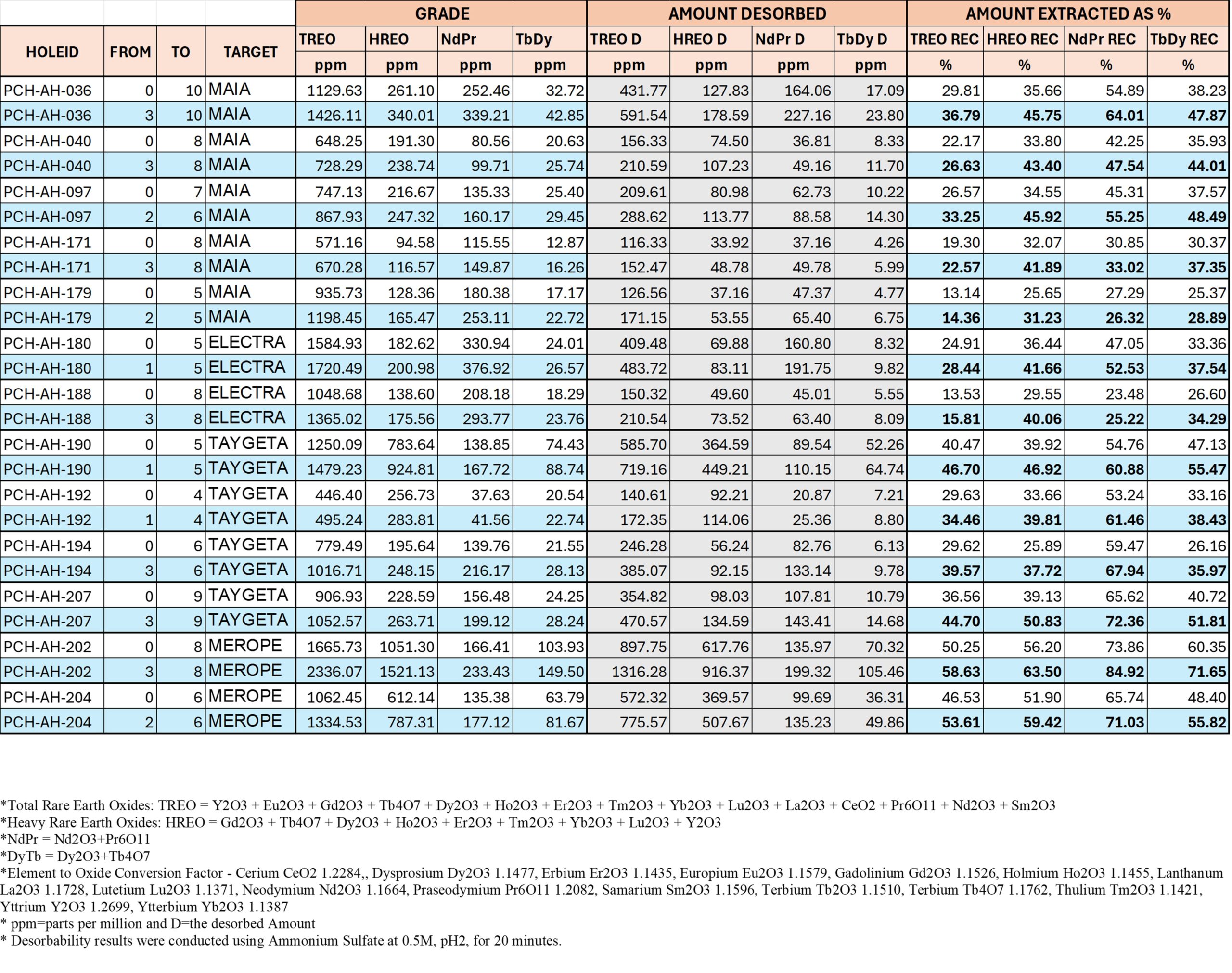
Desorbability testing has been carried out (see February 4, 2025 press release) using ammonium sulfate at 0.5M, pH2, for 20 minutes, with additional testing at pH4 underway. These test programs are intended to better understand the recoverability of rare earths from the clay-hosted mineralization.
Preliminary recovery results from the new IAC zones include:
Maia
TREO recovery up to 36.79%
HREO recovery up to 45.9%
NdPr recovery up to 64.01%
DyTb recovery up to 48.49%
Merope
TREO recovery up to 58.63%
HREO recovery up to 63.50%
NdPr recovery up to 84.92%
DyTb recovery up to 71.65%
Electra
TREO recovery up to 28.44%
HREO recovery up to 41.66%
NdPr recovery up to 52.53%
DyTb recovery up to 37.54%
Taygeta
TREO recovery up to 46.70%
HREO recovery up to 50.83%
NdPr recovery up to 72.36%
DyTb recovery up to 55.47%
These IAC results continue to support the Project’s potential to host a significant clay-based rare earth system with attractive magnet rare earth distribution, including NdPr and heavy rare earth elements.
Locations of the ionic clay discoveries across the Ultra Hard Rock/IAC property
Ionic clay desoprtion results
Ultra Hard Rock/IAC Project - Planned 2026 Work Program
The current 2026 program is ongoing and includes:
3 diamond drills totaling approximately 6,000 metres with 29 drill holes (complete)
4 RC drills with 952 RC holes (underway)
2 auger rigs targeting approximately 500 holes
MRE on the hard rock and IAC discoveries, with a PFS on the IAC to follow
This program is designed to continue expanding both the ionic clay and hard-rock mineralized systems, improve geological confidence, support updated resource work, and advance the Project toward future technical studies, including an updated Mineral Resource Estimate and a Pre-feasibility Study.
Project News
Appia Announces Signing of Share Exchange Agreement with Ultra Rare Earth Inc.
Appia Reports Diamond Drilling on ULTRA HARD ROCK Carbonatite Target Intercepts 300m at 2.55% Total Rare Earth Oxide from Surface Including 1.7m at 14.27% TREO in Goias, Brazil
We use cookies to ensure that we give you the best experience on our website. If you continue to use this site we will assume that you are happy with it.